

As an aging millennial, one of the hardest things I’ve had to accept is that consoles which still feel brand-new to me are actually retro now. Today, November 19th, 2026, marks the 20th anniversary of the Wii’s launch in North America, and having now written that out, my bones have completely crumbled to dust in my chair. I’m not sure I’ll ever be able to truly look at the Wii as retro, but for a generation of people, this was their first video game console. It was also home to The Legend of Zelda: Twilight Princess, the 13th game in the acclaimed action/adventure series, and the previous best-selling entry until Breath of the Wild released 11 years later.
It may seem like a fever dream now, but the reveal of The Legend of Zelda: The Wind Waker had such a polarizing reaction to its art style that Nintendo became scared with future installments. Toon Link was shifted to the handheld Zelda games while the next mainline installment would be a “mature,” “dark” Zelda like fans had been clamoring for. At E3 2004, series creator Shigeru Miyamoto took to the stage to unveil the game to rapturous applause. Whether fans liked it or not, Zelda was going “adult” for its next game.

At the time, I had no strong opinion about what Zelda should be. I quickly became a lifelong fan after Ocarina of Time released in 1998, so I was on board for anything. I had been playing the games as they released since, and Wind Waker didn’t feel out of place to me. Twilight Princess seemed like a natural evolution, with better technology allowing for a more “realistic” style of Zelda game. I was mainly excited because I loved Zelda.
Hindsight, though, is a funny beast. Looking back, the reveal at E3 almost seems like a cowardly move by Nintendo to placate the “hardcore” gamer base with a game that could compete with Sony’s more mature style. Zelda was always about fantasy and exploring magical worlds, but now we were getting grounded, semi-realistic Zelda with no real character of its own. Thankfully, Nintendo used that perception to craft a game which was equal parts dark, epic, and weird. In some ways, the more muted presentation adds an extra layer of bizarreness to characters such as Agitha, Fyer, and the Ooccoo’s.
That’s the part of Twilight Princess that tends to be glossed over the most. You’ll likely see hundreds of blogs and retrospectives going over how “grand” and “massive” the game is, but very few will pick out the quirkier details that make Twilight Princess such an interesting delight. For all of its darker styling, the game winds up being rather whimsical when it comes to side characters. My favorite duo is Yeto and Yeta, a married couple of yetis who live up in Snowpeak Mountain. The entire premise of the dungeon isn’t that Yeto is an evil jerk, but that his wife is sick and he needs you to find ingredients for a soup while he tends to her. That’s so heartwarming that the heat radiating from your body could practically melt all of the ice in your path.
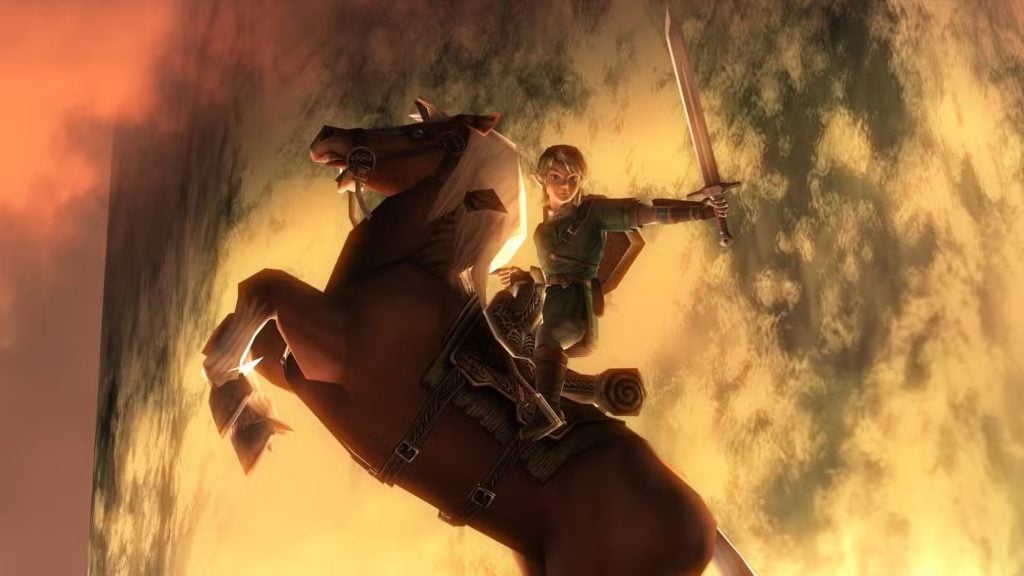
The kids from Ordon Village are another delight, giving Link some extra weight in this world beyond “destined hero.” His upbringing with Beth, Colin, Malo, and Talo takes on a mentor role where the kids wish to be strong heroes like him. When Link gets called to action, the kids even begin aiding him on his quest (after being saved a few times) and establish the best department store in the history of gaming: The Malo Mart! I wish more stores had their own theme songs.
One of the best emotional touches in Twilight Princess, however, is the inclusion of Ilia. There has always been ambiguity with Link and Zelda’s relationship, with some games pinning them as love interests and others as merely reflections of the Triforce. In Twilight Princess, Ilia is very clearly Link’s paramour, caring for Epona and sharing more intimate moments with the famed hero. It’s really shocking in the intro when she “dies,” although Nintendo couldn’t make this game too dark and brings her back later. Still, she serves the as the game’s emotional anchor and gives extra depth to Link’s quest to save Hyrule. It’s similar to how Link in Wind Waker was merely trying to save his sister, though with a more romantic twist.
For as great as all of these moments and details are, I’ve had a rocky relationship to Twilight Princess over the years. I’m not sure if this has been influenced by internet reaction to the game, but I remember thinking it was the “greatest game of all-time” when I first played it on Wii in 2007. Years later during a series replay, I sought out the GameCube version and left feeling a little cold (though the game controlled better without awkward Wii Remote waggle). The game is definitely bloated with padding in certain segments, and its combat design is so lacking in challenge that it can feel as if you’re sleepwalking at points. When I played it a third time for its Wii U HD release in 2016, I found a new respect for the game as merely a tightly directed action game rather than the free roaming adventure the Zelda series normally was.

That’s probably the aspect that has caused such mixed opinion on the game over the years. You could claim that Wind Waker maybe started the trend of shifting Zelda towards a more linear path, but Twilight Princess is the first game in the series where you aren’t given much room to explore things. It doesn’t help that Hyrule Field is devoid of anything interesting to do, but the main story railroads you at various points to do X thing instead of letting you figure it out on your own. Taken as merely a video game, this is fine, but it doesn’t quite speak to the spirit that The Legend of Zelda used to have.
Twilight Princess was such a strong seller, though, that Nintendo seemed to taken the wrong lessons from it. The assumption was that people wanted more linear Zelda games, so the immediately following DS title The Legend of Zelda: Phantom Hourglass, its sequel Spirit Tracks, and the Wii’s swansong Skyward Sword doubled down on that. Those are good games in their own right, but they all share the same faults of exaggerating aspects of Twilight Princess which are decidedly not Zelda-like: a plethora of items which serve only a single function, battles that are unavoidable due to cinematic story moments, and overworlds with little exploration that serve more as extended hallways than actual worlds.
Say what you will about Breath of the Wild abandoning a lot of the Zelda formula, but Nintendo really did need to tweak how it was approaching this series to figure out why its games had started to drop in quality. The 3DS title A Link Between Worlds was a good start as it reversed almost everything Twilight Princess had established, but it still felt lacking in the original spark the NES game had.
Anyway, I’ve gotten off track, so let’s wrap this back around to the game at hand. For all of its faults and the wavering opinion I’ve had of it over 20 years, The Legend of Zelda: Twilight Princess remains a well-executed action/adventure game that should have maybe marked the end of a certain era for the series. It has a wonderful art style, great emotional depth, and some truly fascinating dungeon concepts. I’m not sure I’d ever want to see Nintendo copy this specific template, but then the Zelda series has never been one to rest on its laurels. If nothing else, just release the HD port on Nintendo Switch already!
Check out more Zelda content
Grand Theft Auto VI dethrones Zelda: Ocarina of Time as the highest-rated game ever
The Game Awards reveals its 2026 nominees with Zelda: Ocarina of Time taking a GOTY spot
Zelda: Ocarina of Time remake is the US’ best-selling physical game of 2026 so far
Leave a Comment

Written by Peter Glagowski
Peter has been a freelance gaming and film critic for over seven years. His passion for Nintendo is only matched by the size of his collection.
