


For the last 20 years, I’ve been what many would call an obsessive video game collector. Nearly every weekend, I could be found at the crack of dawn at garage sales, flea markets, thrift stores, and estate sales searching for Nintendo treasures to add to my collection.
Over the decades, those early mornings have led to some incredible finds. I’ve rescued a broken Pokémon Snap Station and restored it to working condition. I’ve uncovered countless rare NES, SNES, and Nintendo 64 games, along with promotional displays, store signage, and other pieces of Nintendo history that most collectors never get the chance to see.
This story also involves finding a new treasure, but something way outside of what I ever expected to discover. So strap in, get yourself a snack or a cup of coffee, and let’s talk about how I found 97 never-before-seen variants of one of the most popular games in history.
The Discovery
The story starts in a small downtown retro store called OneStopWonders. The owner, Kevin Braun, is somebody who I’ve known for quite some time. He’s owned retro shops in a variety of sizes over the years, and I’ve purchased more items than I can count from his stores over that time.
Kevin started becoming interested in pinball machines, a hobby that I coincidentally shared, and one of his machines broke down. He asked me if I’d be willing to come take a look, and I was thrilled to do so. After about a day or two of tinkering, we got it back up and running. As we shared a moment of excitement seeing the game spring back to life, we started talking a bit about his shop and his plans for the future.
Kevin knew that I ran a website, and selling things online was something he really wanted to start doing. So an agreement was struck, and Kevin and I started working together selling some of the retro games from his store online. For me, it was an absolute thrill. There’s nothing in life I like more than sifting through old retro video games.
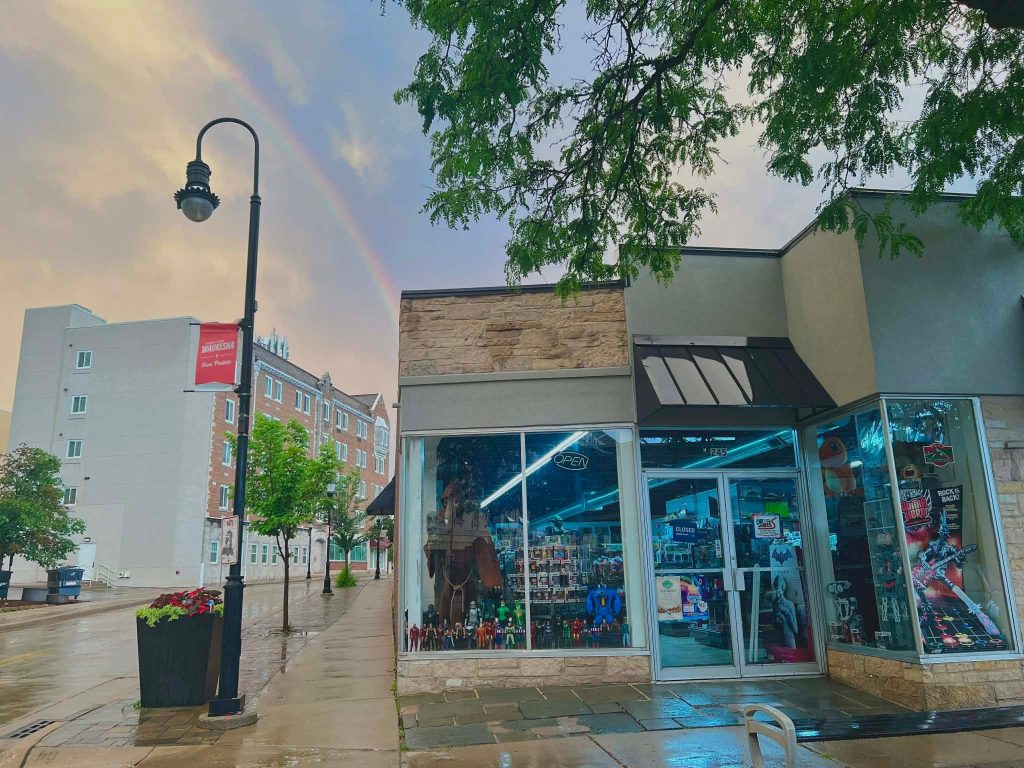
OneStopWonders in Waukesha, WI
Some time later, while we were discussing what items to list next, Kevin started telling me stories about some of the strange items that had made their way into his shop over the years. One of those stories involved a man whose grandfather owned a precious metal recovery service back in the late ’80s and early ’90s.
The story I was told was that he had a contract with many vendors to extract gold from circuit boards if a vendor wanted to get rid of old inventory. One of those vendors happened to be Nintendo.
According to Kevin, the box was jam-packed with NES games. The story goes on to reveal that the box of games was supposed to be melted down and salvaged for the gold on the contacts of the pins. But for whatever reason, this box never made it to salvage. Instead, it sat in a garage for over 20 years before finding its way into Kevin’s shop.
Kevin confessed that he had no idea of the value of what was in the box and simply saw an opportunity to sell each game for roughly $10 to $15 apiece. He purchased the box, put it in his storage unit, and there it sat untouched for several years. The truth is, Kevin completely forgot about the purchase. If you look at some of the other things he’s bought over the years, though, that wasn’t an uncommon occurrence.
After Kevin finished his story, I immediately could tell that the blood had drained from my face.
“Can I see the box? Do you still have it?”
Kevin responded, “Yeah, follow me!”
The games had been a few hundred feet away from me all this time.
A short walk to his storage unit, and tucked underneath boxes of old Halloween decorations, it sat, untouched for years.
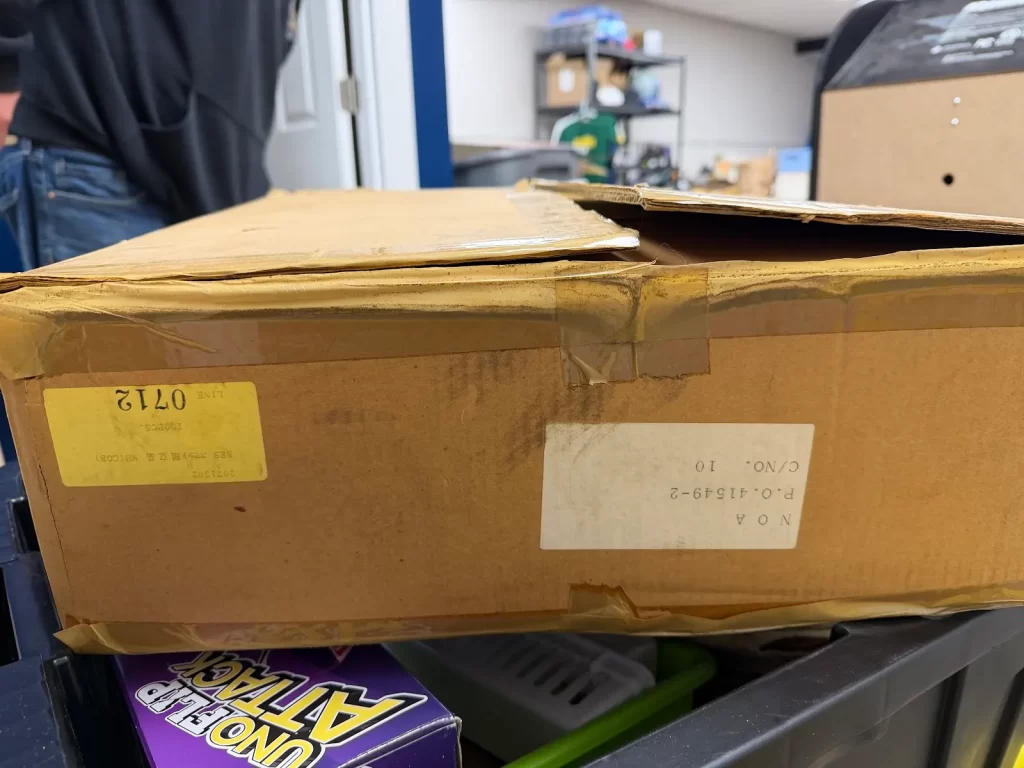
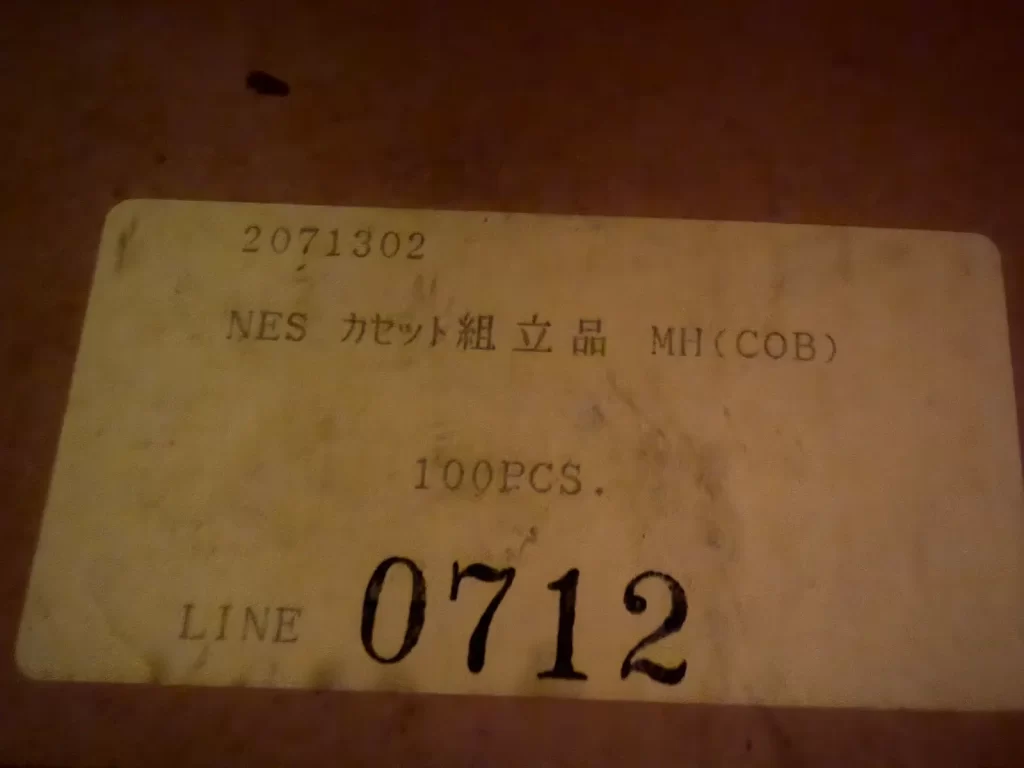
The first sticker that I saw on the front of the box was in Japanese, but in English the letters “NES” were clearly spelled out. At this point, I had no idea what games would be in this box. So I pulled it out, hands shaking, and opened it up for the very first time.
Nothing could quite prepare me for what I saw inside the first time I opened it up. Rather than explain it to you, I think it’s better that I show you.
This is what I saw when I opened this box.
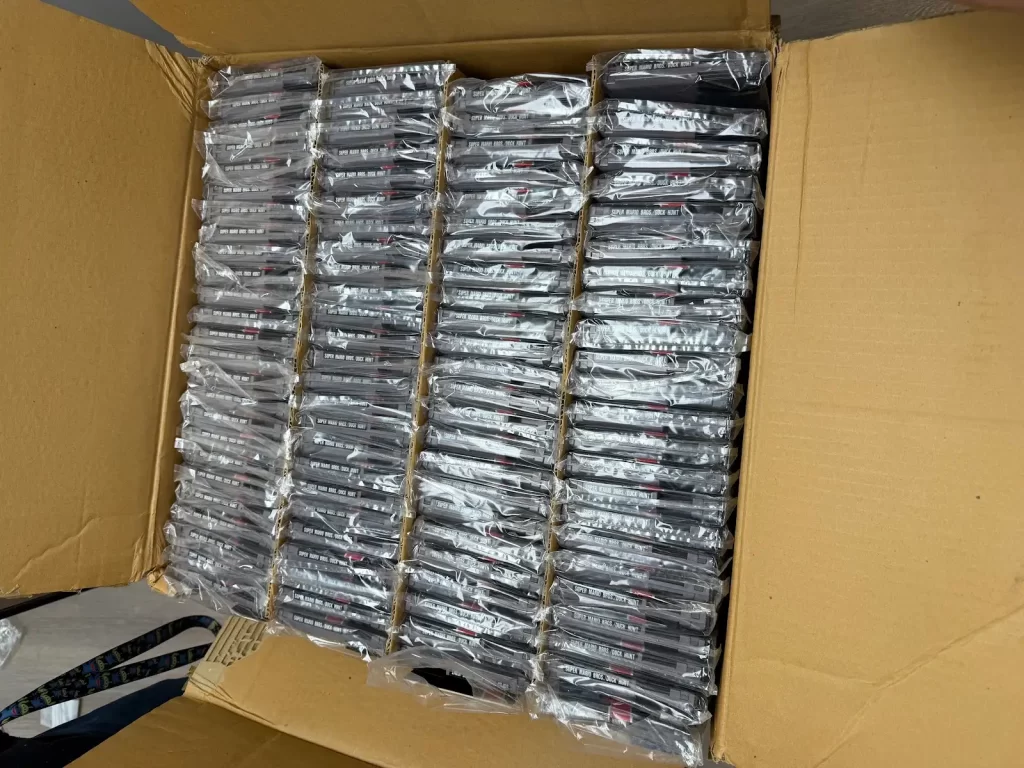
My heart stopped when I first saw this.
Inside, were 97 individually wrapped, brand-new copies of Super Mario Bros./Duck Hunt. Each game was wrapped in the same baggie that would have come in an official NES console bundle. Tucked behind each cartridge was a brand-new, absolutely pristine manual for the game as well.
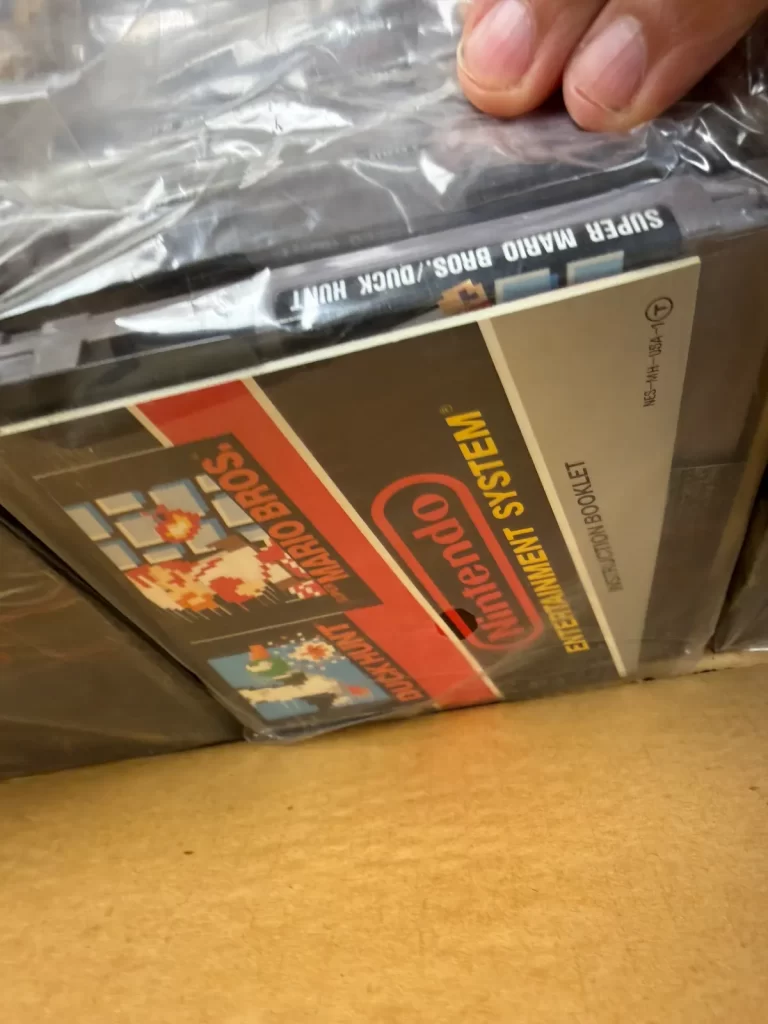
Seeing brand-new Nintendo games is an incredibly exciting thing for a game collector. But seeing 97 of them all lined up, all of them pristine, nearly knocked me straight on my ass.
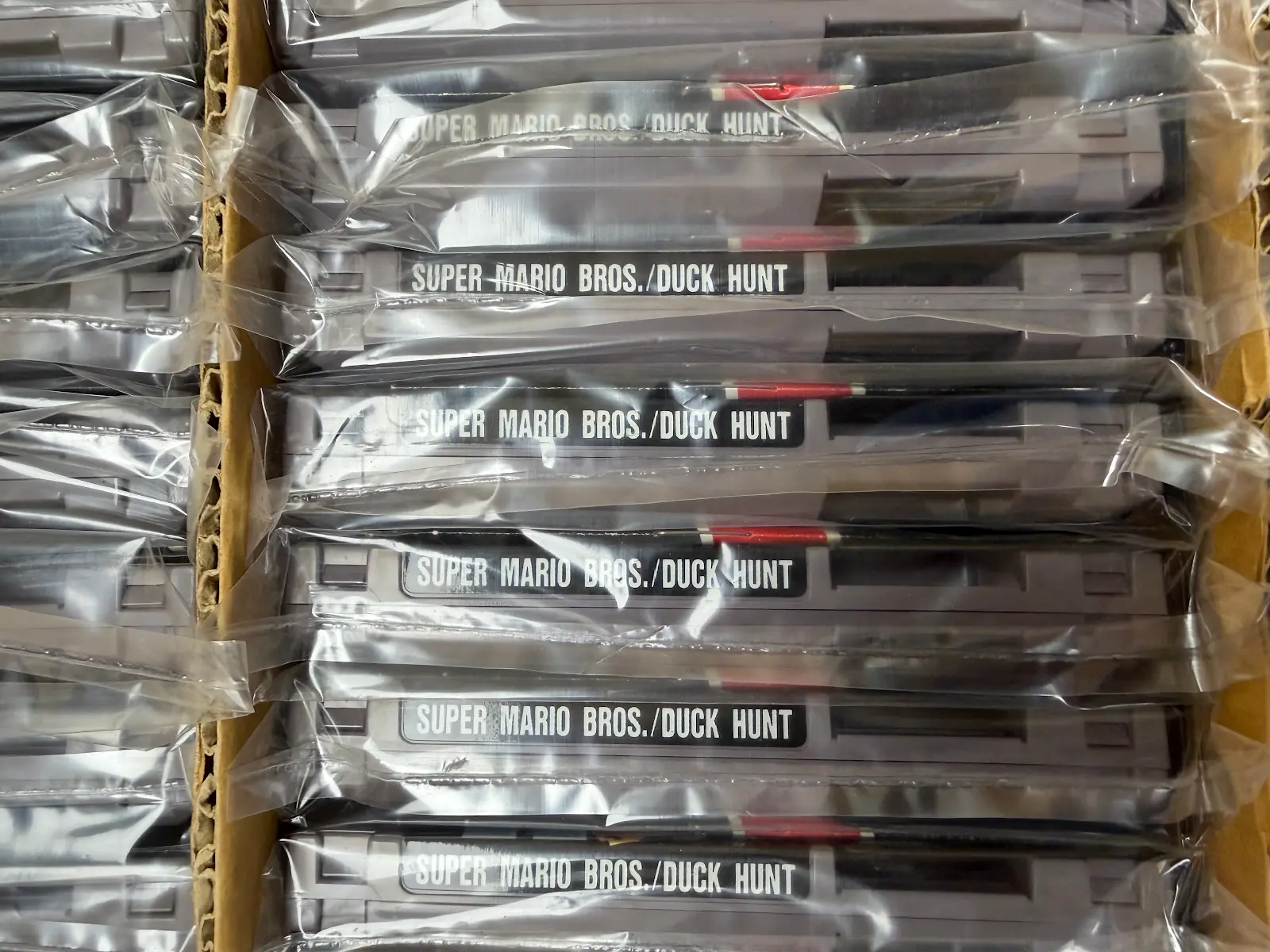
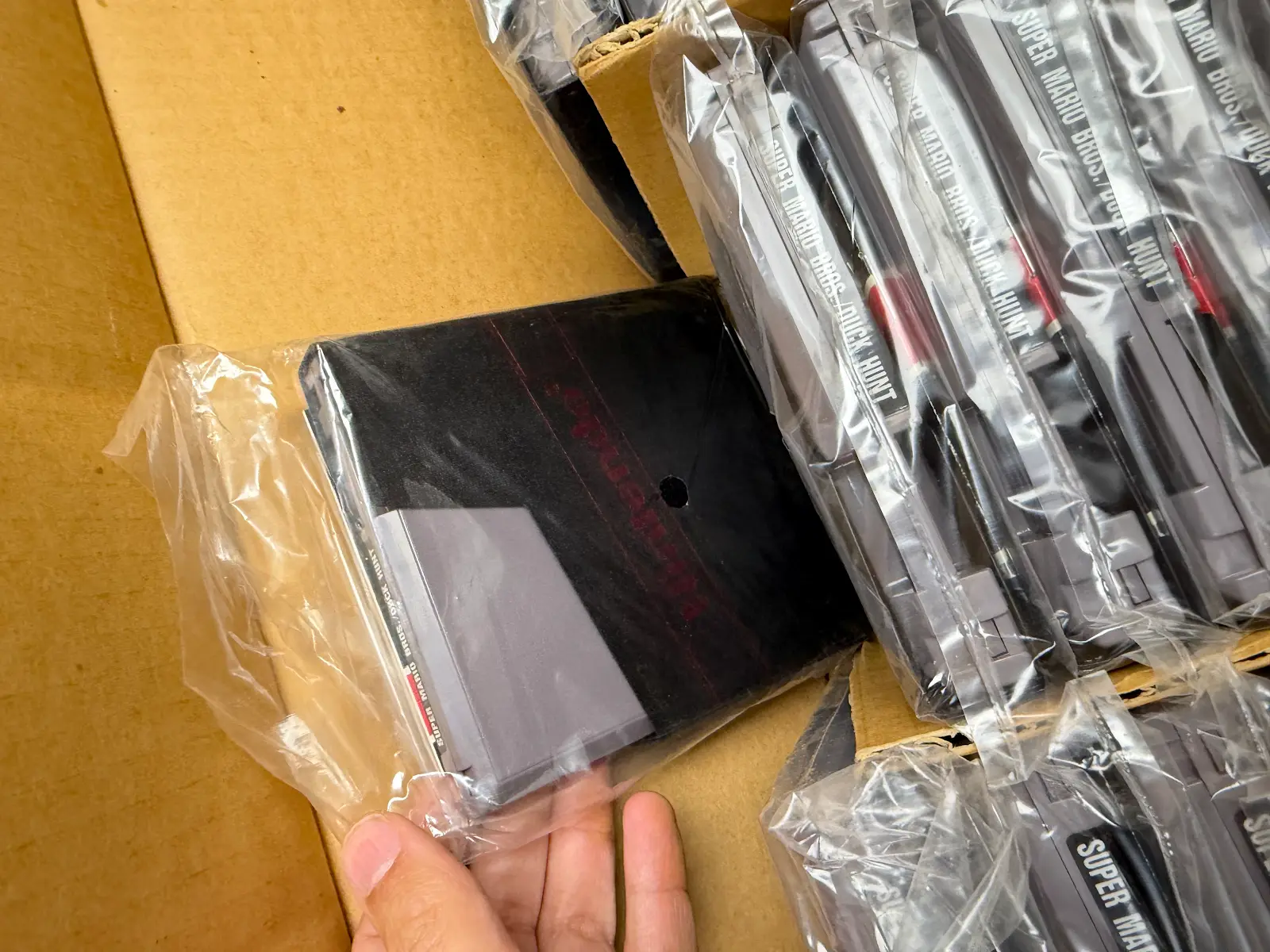
But at the end of the day, this was Super Mario Bros./Duck Hunt, one of the most common games ever produced. And while these were uncirculated, brand-new copies, I wasn’t quite sure what kind of value we were really looking at.
Kevin confessed to me that he had thought about this box recently and was getting ready to take it out of storage and sell each game for $14.99 apiece.
We sat there for some time deciding what we should do with this box, and eventually we both agreed that I would take the box with me, and do some research.
So I covered the box in plastic, walked in the rain back to my car, and took it home.
That’s where this story takes yet another unexpected turn.
The Box
The first thing that I noticed when I saw the box in storage was the Japanese sticker. But beyond that, two additional stickers were there. Next to the Japanese text was a sticker that read “NOA” and had a P.O. Box for where it was sent. On the other side was an inventory sticker with a product number, description, the quantity of cartridges in the box, and the date that this box was sent out.
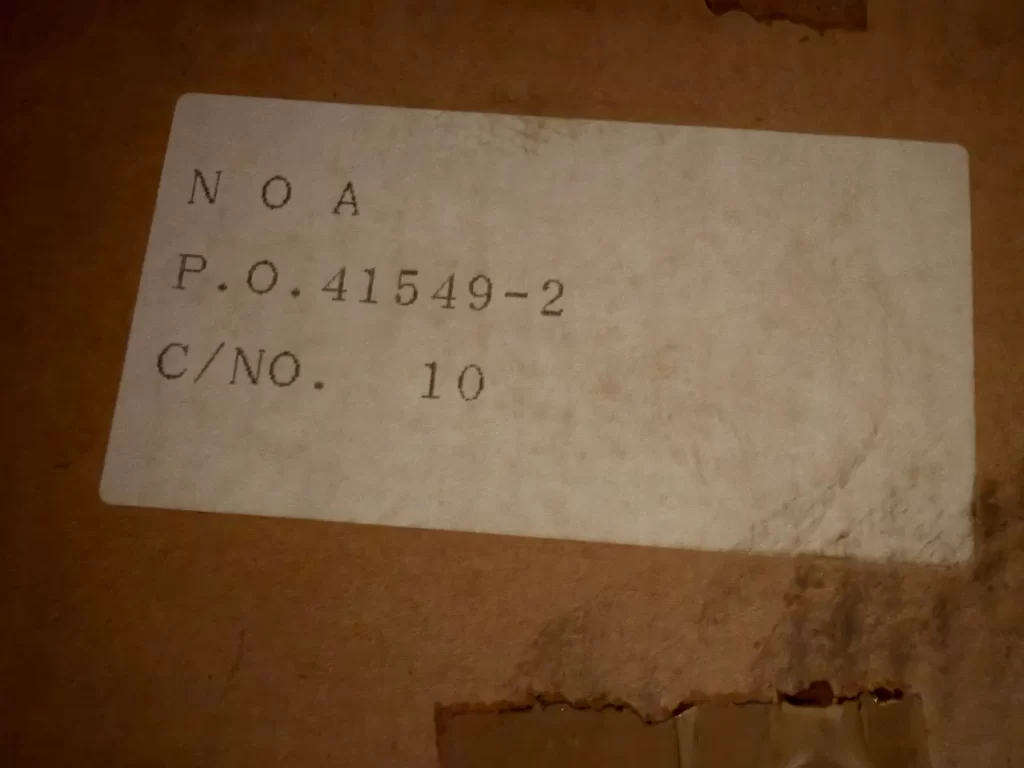
The description read “Mario – Hunt Remanufactured NES.” The quantity read 100, which means three games had escaped the box at some point over the past 30 years. The date read 12/19/95, very late in the NES lifespan.
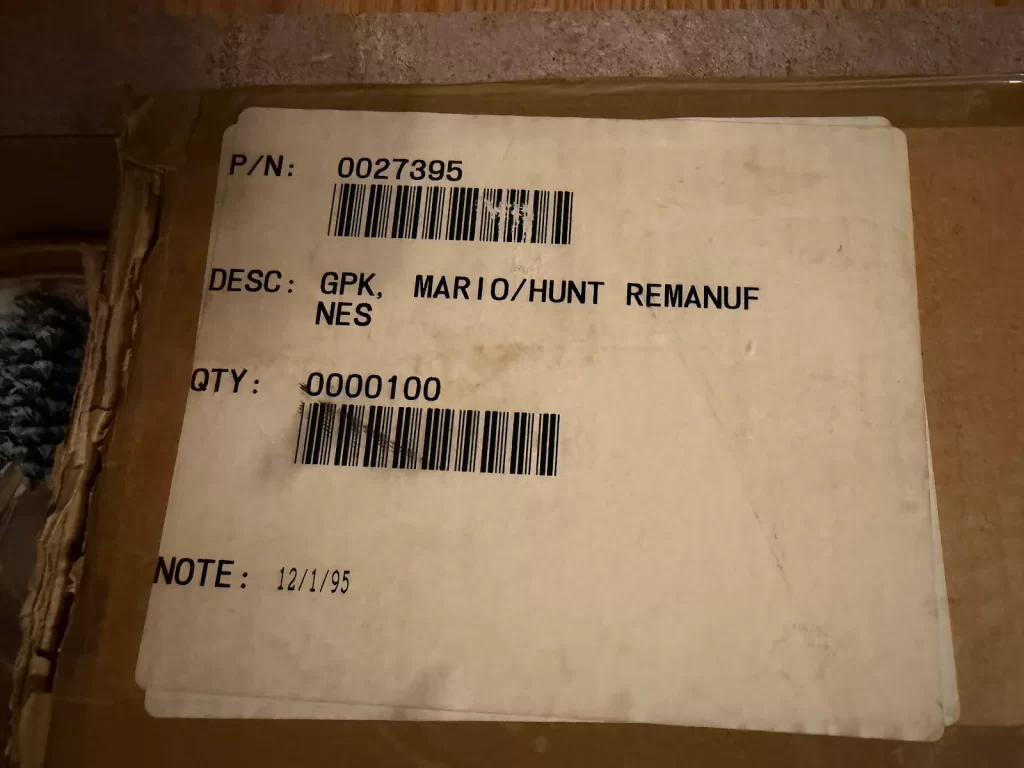
As a guy who just loves Nintendo history, I was more in love with the box than I was with its contents at the time. It’s rare to see factory shipping boxes of old Nintendo games, let alone one that originated from Japan, was sent to Nintendo of America, and finally was sent off to a recovery center in the Middle of Nowhere, Wisconsin.
Finally, I decided to find out what the Japanese label said. After running it through a translation app, I found that it read, “NES cassettes, assembled product, 100 pieces.”
Nothing earth-shattering, but at least good confirmation that this was the original box these games came in.
With that, I snapped some photos and uploaded them, along with a post describing what I had found, to a high-end gaming Facebook group that I am a part of. I asked if anybody had seen anything like this before, and judging by the responses, no one ever had.
That’s when the messages started to come in.
The Realization
As quickly as I put the post up, the direct messages started pouring into my inbox. Some collectors asked to buy all of them. Some people said what I had was clearly counterfeit.
But two messages stood out even more.
Around 15 minutes after the post had gone live, I received messages from two separate directors at two separate grading companies. Both of them almost immediately told me the same thing.
Something was strange about these cartridges.
Something about the images that I had sent set off a red flag in both of their minds. I was immediately asked for more photos of the cartridge and the manual, and I was even asked to take one of the cartridges apart so the board could be inspected.
Luckily, I’m the kind of nerd who has security-bit screwdrivers sitting on my desk for just this occasion.
So I got to work and took one of the cartridges apart.
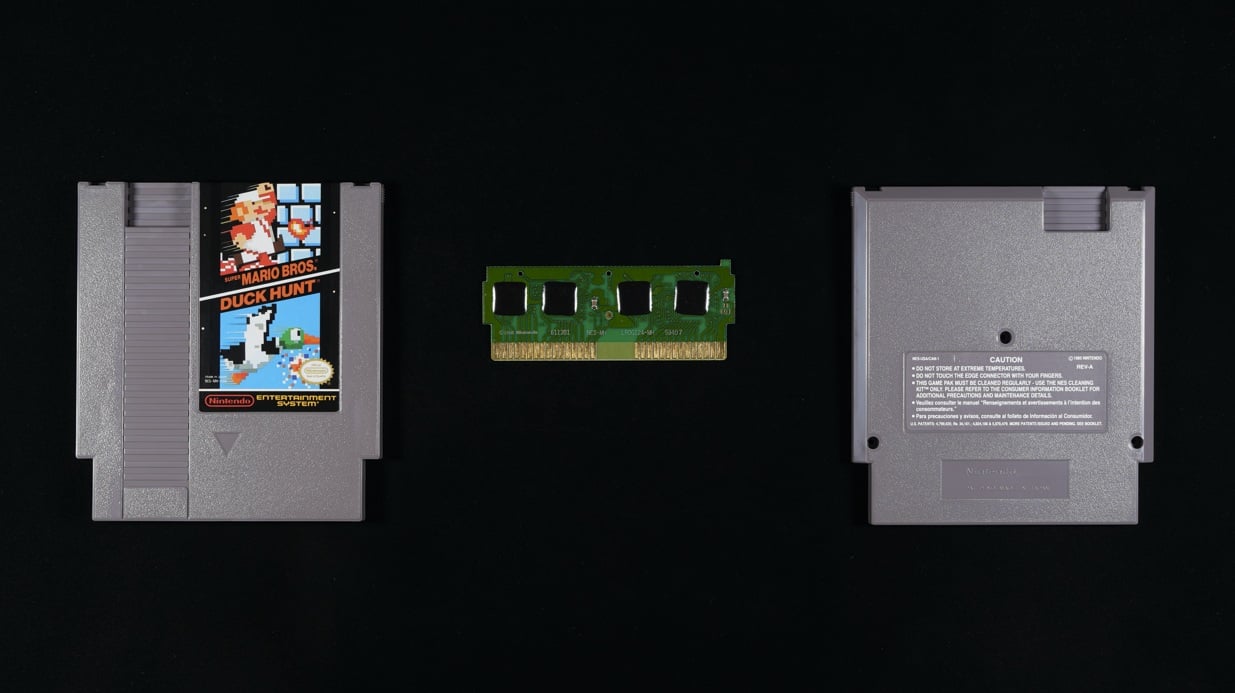
After snapping all of the photos they had requested, I received the call I never expected. What I had found wasn’t just a box of pristine Super Mario Bros./Duck Hunt cartridges. It was an undocumented, never before seen variant.
The back label was unlike anything that had been documented before. Instead of the standard English-only text, it featured multiple languages. The manufacturing codes on both the cartridge and instruction manual also differed, indicating these games were produced in late 1993. Even the manual contained previously undocumented text. Known manuals include the phrase “maintenance or repairs,” while this newly discovered version instead reads “maintenance or service.”
Special thanks to Joseph Leo for his help identifying and documenting the differences found in these cartridges and manuals.
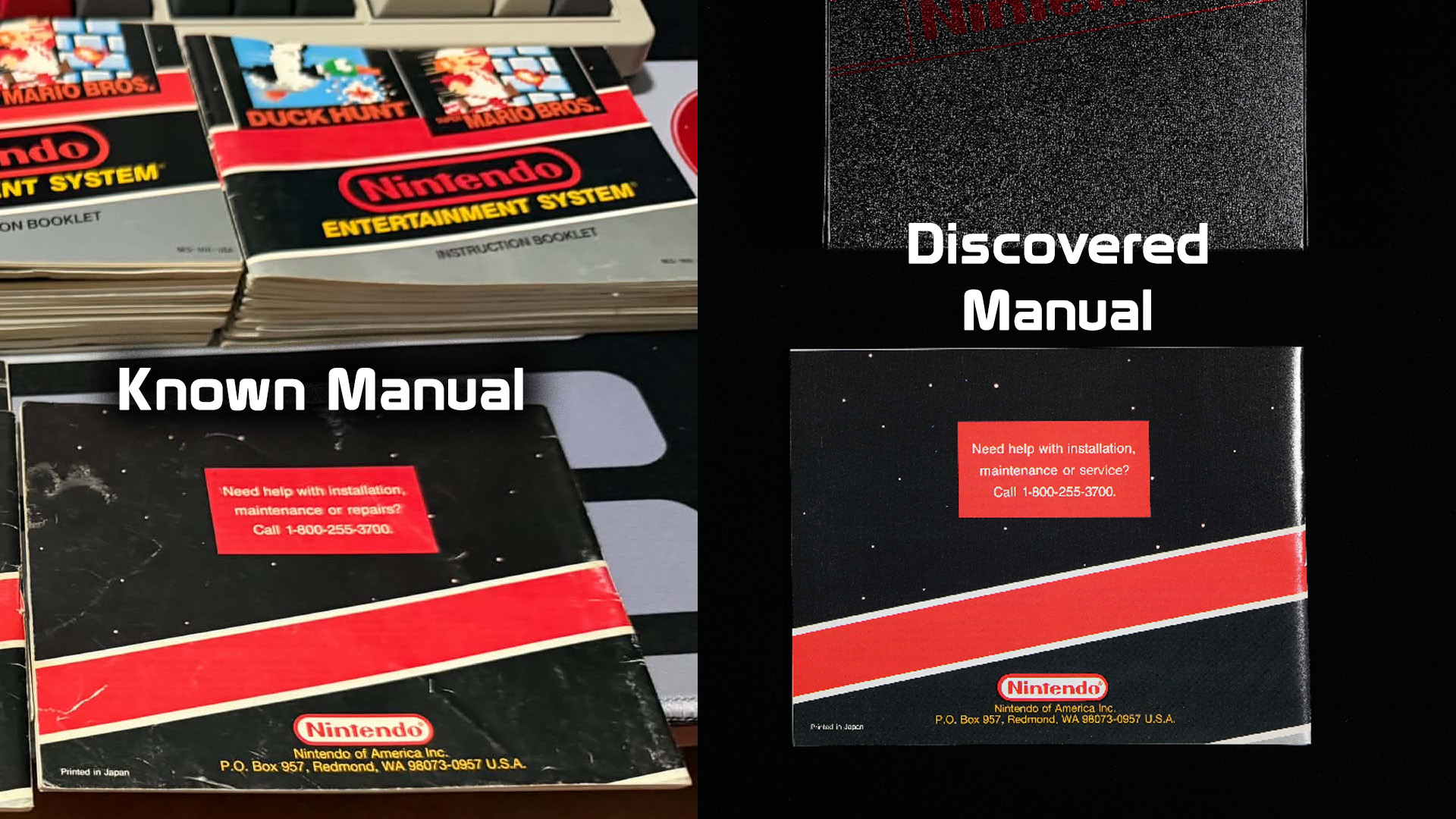
“or repairs” on known manual vs “or service” on our manual.
Perhaps most puzzling of all, the manufacturing dates on both the cartridge and manual come after every known Super Mario Bros./Duck Hunt bundle these games could have belonged to.
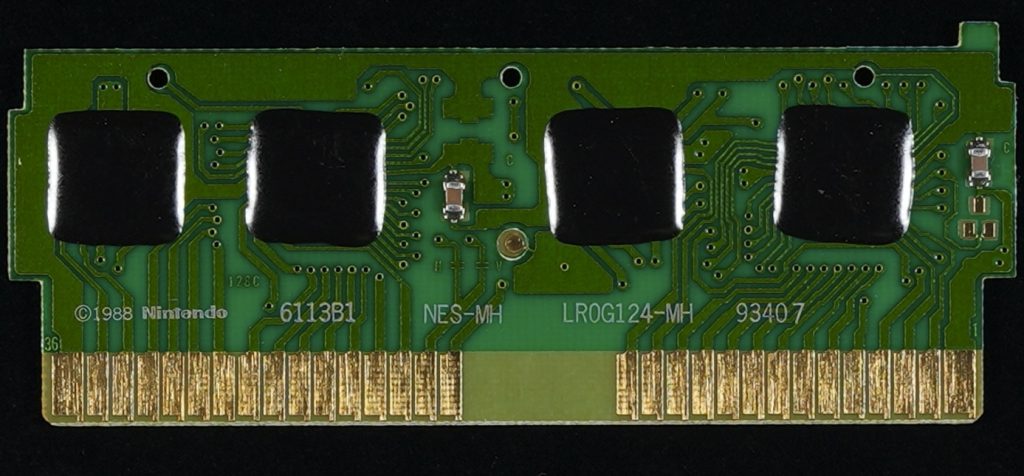
The date code 9340 translates to the 40th week of 1993, which corresponds to late August.
What we had found was the very last production run, and an undiscovered variant of Super Mario Bros./Duck Hunt. Arguably one of the most beloved, and one of the most documented games in Nintendo history.
Not only that, but nearly every cartridge was pristine.
But that raised an even bigger question: Why were these created in the first place? Why would Nintendo manufacture new pack-in games in late 1993 for a console bundle that was no longer being sold?
Our best theory is that these cartridges were produced either as replacement stock for warranty repairs and refurbished systems or for a bundle that was planned but never released. The truth is, though, nobody knows for certain. For now, the exact reason these cartridges were manufactured is just one more mystery surrounding this incredible discovery.
The Plan
After some back and forth with Kevin, we decided to send the games to one of the grading companies that reached out: PSA. They wanted to inspect them, authenticate them, and find out exactly what these things were.
After a brief conversation with one of their directors, it was decided that instead of mailing these 97 cartridges to them, I would hand-deliver them the next day.
So, I packed all 97 cartridges into my carry-on luggage and boarded a 5 a.m. flight from Milwaukee, Wisconsin, to Orange County, California. There aren’t many things that will make a grown man sweat quite like walking through a TSA checkpoint with 97 little circuit boards in his bag. I was convinced I was going to get pulled aside for questioning, but apparently they’ve seen far stranger things. To my surprise, I made it through security without so much as a second glance.
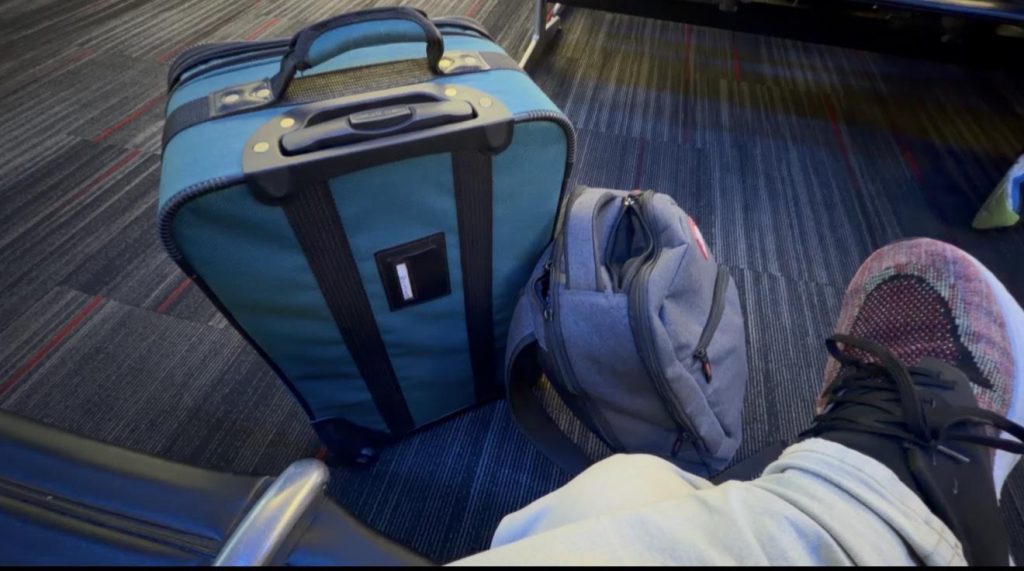
Just a normal guy with 97 NES games in his carry on.
After arriving in California, I was picked up at the airport and taken to PSA’s headquarters. I’ve had quite a few things graded by PSA in the past, so it was pretty fun to see just how huge their campus was.
When I arrived, I unpacked the games and briefly chatted with one of the directors before I left. From what they could see, there was very little doubt that these games were real. Of course, the grading process would 100% confirm that, but at face value, this looked like the real deal.
I was also told that the games were in remarkably good condition, some of the best they had ever seen.
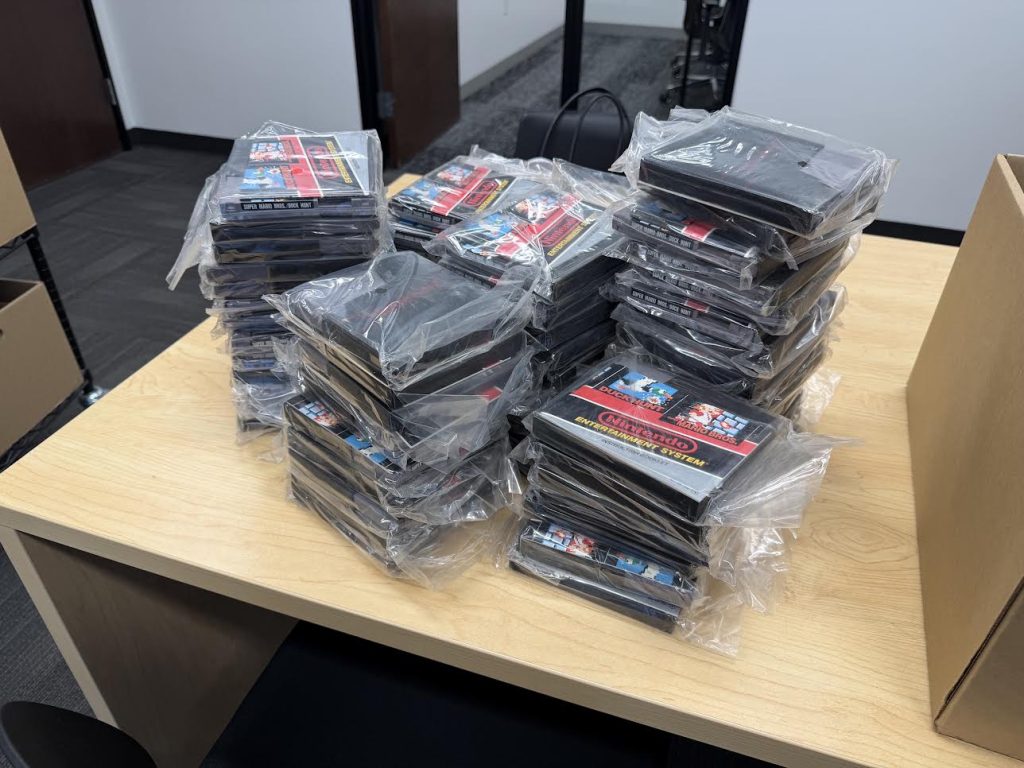
So I left them there. I was told the process could take several weeks and that they would let me know as soon as they had an idea of what they were working with.
And just like that, the cartridges were gone from my possession, and I headed home.
One of the nice things about PSA is that they give you the ability to see the status of your grading (for video games, at least) right on their website.
So over the next few days, I compulsively refreshed the page to see if any of them had been graded and whether it was possible that at least one of these would receive the world’s first PSA 10 for an NES cartridge.
Luckily, I would not have to wait very long. About a week later, the first grades started coming in.
And there it was.
12 games in total had been graded, with a little over half of them receiving the incredibly high score of 9.8, several grading a nearly as impressive 9.6, and one receiving the coveted, never-before-seen-on-an-NES-cartridge PSA 10.
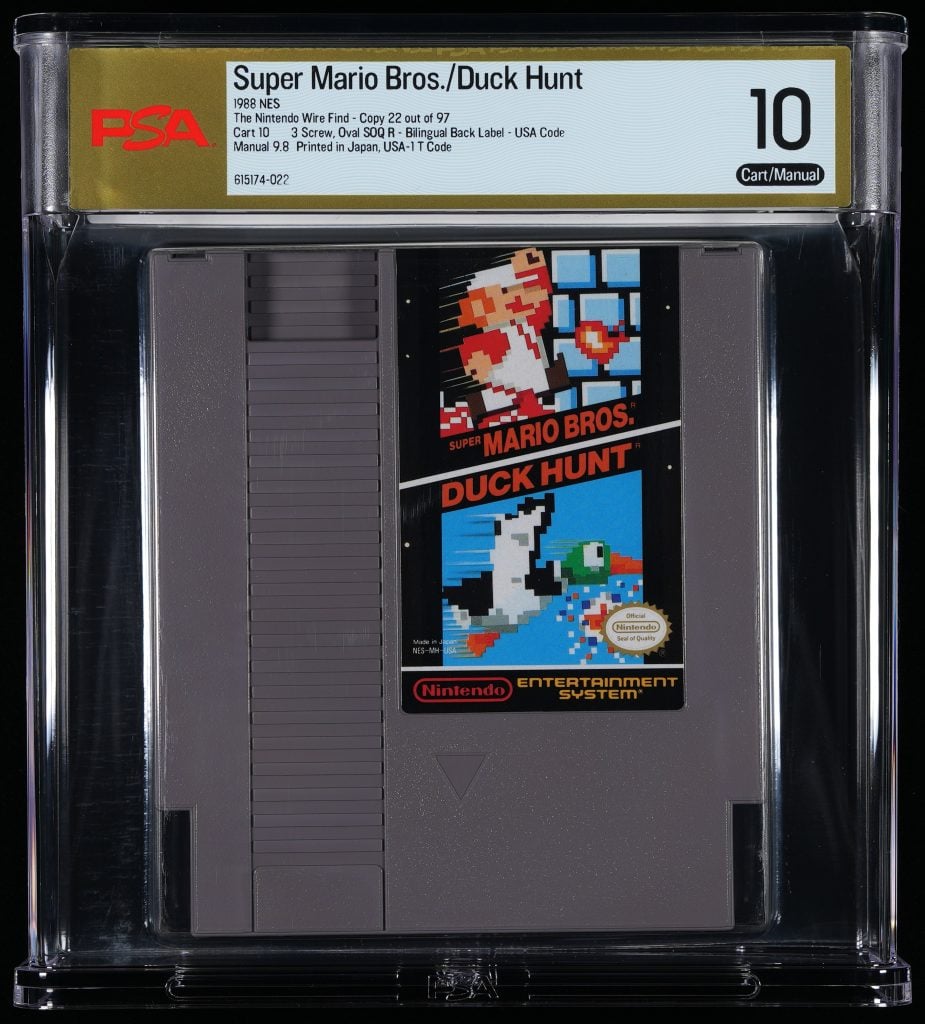
A world’s first.
As the days went on, more cartridges completed the grading process. When all was said and done, a total of five PSA 10 cartridges were graded.
Shortly after, the boxes started arriving back home. 12 cartridges at a time were sent back to us, and I watched every tracking number like a hawk, ensuring nothing looked off during transportation.
Now What?
So what’s next?
What do you do with a collection like this?
Well, that’s the million-dollar question.
Kevin and I will be keeping an undecided number for ourselves. Some of the others will be auctioned off, and others will have charity auctions set up in the very near future.
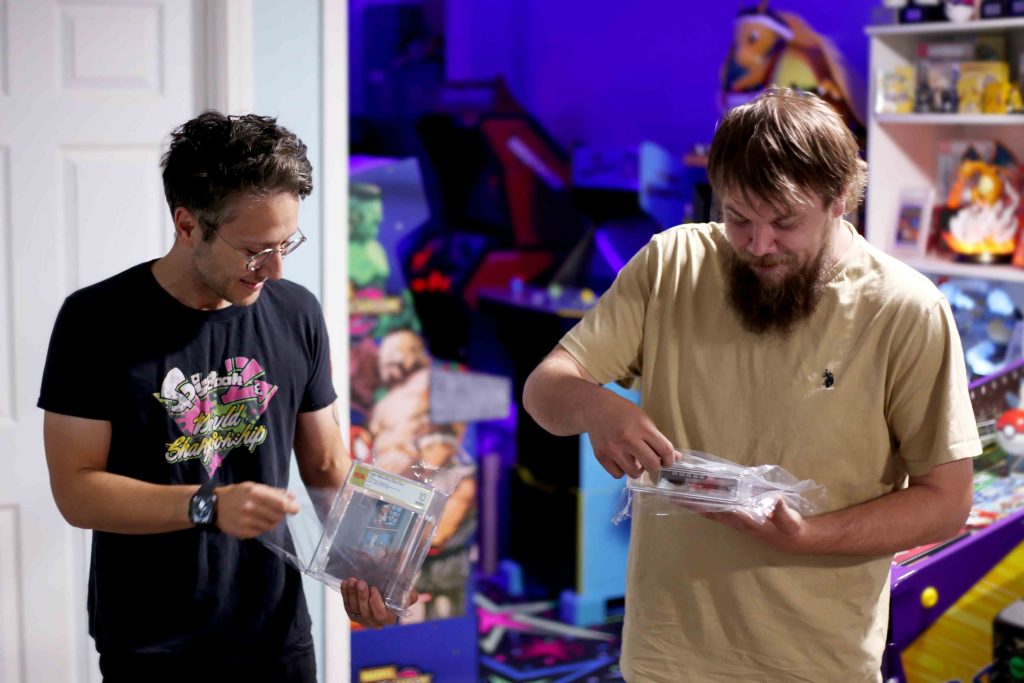
Jason (Left) and Kevin (Right) looking at the PSA 10s for the first time
I’m happy to report that the first three games will be auctioned on August 12th at Goldin Auctions, including one of the PSA 10s. We will have more information about this auction in the immediate future. I’m also thrilled to say that full scans of the instruction manual, along with photos of every angle of the cartridge, will be available online in the coming days.
So that’s the story as of right now.
As a lifelong game collector, I don’t think I could have dreamed of a more exciting story. A box that was originally meant to be destroyed, and cartridges meant to be scrapped for the gold in their pins, somehow made its way from Japan to Seattle, Washington, to a smelting factory, and finally landed in a small retro shop in a small city in southeastern Wisconsin.
Sometimes the truth is a lot more exciting than fiction.
Stay tuned!
Special thanks from the Nintendo Wire team: Over the past month, we had the privilege of speaking with many individuals in the video game preservation and grading community who helped us better understand the significance of what was discovered. We would like to thank Kenneth Thrower of CGC Video Games; Claire Shelton and Dan Gomez of PSA Games; Frank Cifaldi, founder and director of the Video Game History Foundation; and Joseph Leo, who generously shared images from his extensive collection of game manuals and cartridges.
Leave a Comment

Written by Jason Ganos
Nintendo super fan since birth, Jason is the creator of Amiibo News and editor-in-chief at Nintendo Wire. One of his life goals is to provide the latest Nintendo news to fellow gamers with his natural know-how.
