


Like a handful of current and former colleagues here at Nintendo Wire, I know exactly where I was the morning of June 13th, 2017. Packed into a hotel room turned office, we’re watching Nintendo’s digital Spotlight presentation, typing up news articles and getting excited for our favorites — I got way too hype over Clean returning as a copy ability in Kirby Star Allies. That outburst was nothing compared to the collective fervor when, defying all odds and blowing all minds, Metroid Prime 4 was announced.
None of us would’ve guessed it’d take eight and a half years to happen. The Kirby game I mentioned? That came out nine months later. Two other 2D Metroid games and a remaster of the original Prime would all come out between then and now. And while it’s still available on Nintendo Switch, what would eventually become fully titled as Metroid Prime 4: Beyond would find itself a new home on the Switch 2.
With that kind of timeline and the snowballing anticipation to match, could Samus Aran’s return to a first person adventure possibly live up to the expectations of those ten screaming Nintendo fans back in 2017? Of fans around the world? Of course not. What it does manage to do, though, is deliver on several fronts the series has proudly upheld in its console offerings — its visual presentation especially — but not without making some questionable, detrimental choices.
Return of a Legend
Beyond moves almost completely away from the core narrative arc of the previous trilogy, and nearly every other Metroid game before it. There’s no mention of Phazon, the Space Pirates are only given a brief showing in the game’s prologue, and the titular creatures barely do any better. While that could be upsetting for longtime fans, it ultimately makes the game accessible for anyone to jump in — don’t let the “4” in the title deter you.

The game takes Samus to planet Viewros, stranding her on a planet whose now-lost civilization (the Lamorn) once thrived on their psychic capabilities. Their last remnants deem Samus their chosen one and task her with preserving their cultural legacy. It isn’t touched on directly, but I appreciated Samus (herself the scion of a lost civilization) shouldering this burden. It’s a shame the game doesn’t explore this aspect of her character, as it was something the excellent Metroid Dread addresses more overtly.
Instead, the game hones in on a different plotline for the vast majority of its time. Stuck on Viewros, Samus has to locate five teleporter keys to warp herself off world and to more familiar corners of space. Unlike past entries, she’s not alone in these circumstances. Five Galactic Federation Troopers have been scattered around the planet’s biomes, leading to sections where they accompany the famously stoic, solitary Samus on her quest.
As core as an isolated, moodier atmosphere has been to the series, I don’t have an inherent problem with Samus having allies or even partners during operations. That doesn’t inherently rob her of her strength or identity, and I’d argue the concept has greater narrative potential — her mythic reputation in later entries has to come from somewhere.

Instead, Prime 4 uses these characters in service of its linear progression, more interested in moving you along from A to B with light banter. Much has been said about Myles MacKenzie and Nora Armstong in particular, knocking their lighter demeanors and hero worship of Samus. I’d sooner decry them for other qualities (more on that later), but as a whole the ensemble is as inoffensive as they are underexplored, ironically making the personality-less robot VUE-995 the most entertaining and sniper Reger Tobaki (who actually gets good one-on-one time with Samus to discuss his past and his faith) the most compelling.
Opening With the Finest
If it isn’t clear, Metroid Prime 4’s story and cast didn’t really draw me in. What did draw me in was its world, and it’s here that it most embodies what past entries did so well. Viewros may be a checklist of biomes, but it does these areas splendidly. Your first real taste of this is Fury Green, a lush and brightly lit jungle graced with immaculate music. It may only have a few puzzles and collectibles, but as an introduction to this planet it’s perfect.
That it’s followed up by one of the most unique settings in any of these games — a motorcycle factory located in a perpetual lightning storm — makes the earliest hours of Prime 4 its strongest. Even when the action shifts to more standard video game areas (The ice one! The lava one!), there’s strong world building to be found in both in the areas themselves and the trademark, optional scans dotted throughout.
On top of that, it’s simply a gorgeous game through and through. This is the new gold standard for visuals on the Switch 2, and another proud Prime tradition upheld in Beyond. Players can opt for either the 4K/60 fps Quality mode or the 1080p/120 fps Performance mode, with even handheld being consistently stunning on the newer console.
That praise starts to fall away with the game’s desert overworld and late underground mines portion. While they still manage to look gorgeous, they’re comparatively boring next to the other areas and setpieces, and come with distinct flaws that detract from the overall experience. It’s unfortunate, as depending on how you approach completion it’s likely that your last few hours with the game will be more of a drag than they should be, save for the grand finale.
Barren Wastes of Time
As strong as Prime 4’s regions and exploration can be, the macrogame connecting them is its weakest element. Rather than an interconnected map, each of the regions is instead sectioned off with a central hub serving as a mediary. Sol Valley, the aforementioned desert, is traversed primarily with Samus riding the coolest upgrade in the game — a motorcycle called Vi-O-La.
Unfortunately, it’s a mostly barren and underwhelming wasteland, with only a few shrines, Federation crash sites, and bike upgrades dotting the landscape. You’ll get mobbed by the same few enemies and run over pile after pile of green crystals as you cross its dunes, all to muted ambiance. I can’t prop up this structure as anything but tedium.
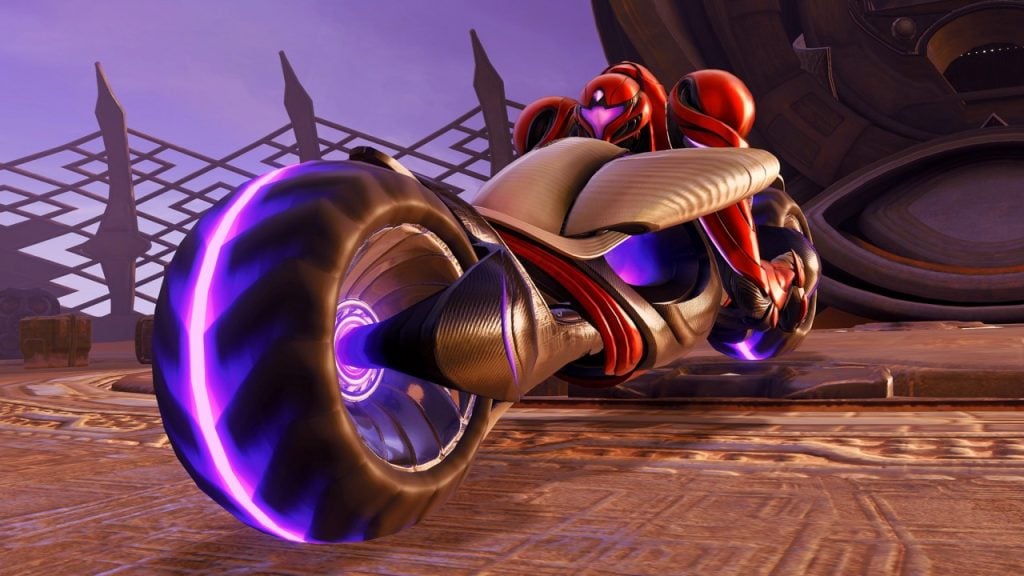
When I first rode Vi-O-La through Sol Valley it seemed like the game was taking an open and nonlinear approach, urging me to venture out and see how far I could get in any of its sections. A bit later though, I got a radio call from Myles MacKenzie, telling me exactly where I should go to move the plot along. On the one hand I was thankful, as it meant I wouldn’t waste more time in the desert, but being told “Hey, check out the Ice Belt!” and then having it flagged on my map was a bit jarring.
I got used to this approach over time, and it fits into Prime 4’s overall rhythm, but I can’t quite say that to another recurring aspect. In past games, both Samus’s resourcefulness and the unique nature of her Power Suit is emphasized when she acquires suit upgrades and additions to her arsenal. In Beyond, she instead finds chips that then have to be taken back to base camp to be manually installed into her Arm Cannon. It’s…odd. Even within the narrower view of the Prime series, it feels like forced backtracking instead of the more natural flow of past games.
It doesn’t help that the elemental shot types you get from these chips feel more like keys to new areas than something to enhance puzzle solving or explore in combat. The theming for the game’s other, standardized power-ups also feels a little tacked on. Calling something Psychic doesn’t make it so, though I will concede that the suit you spend the majority of the game in is an excellent look.

Even though the game doesn’t really explore new ideas when it comes to your toolkit, it still applies enough ingenuity (outside of the shots) to make their utilization as enjoyable as any other past entry. That, along with the aforementioned regional setpieces, keeps propelling your forward at a solid pace. It’s a much more linear game than past Metroids, but outside of the sandy interludes and homestretch that structure works.
You Again?
I do have to take a moment to criticize one particular element of Prime 4 though, and that’s its enemies. While each specific area has a few endemic lifeforms for Samus to contend with, and boss fights are appropriately distinct and challenging affairs, I was so sick of Psy-bots and Grievers by the time I rolled credits. These two enemies (along with a couple others) are so recurring that they become obnoxious. Grievers in particular are constantly accompanied by a dull shriek (I didn’t think that was possible), which makes them doubly annoying and dilutes their place in the game’s narrative.

Some credit where due, though. This game has one of my favorite approaches to controlling a first person shooter. Playing with a Joy-Con in each hand on Switch 2, you’re able to go from motion aiming to mouse controls seamlessly. Whenever I felt I needed more precision, particularly for a few boss fights, going from my preferred handheld style to that approach on my TV got the job done no problem.
Speaking of boss fights, there’s also the matter of Sylux. For the unfamiliar, Sylux was introduced in the DS’s Metroid Prime Hunters and has made sporadic appearances in stingers for other past Prime games. All we’ve known of him is he has a particular hatred of Samus, he wears modified Galactic Federation armor, and he’s messing with Metroids. These elements come together as the main connective piece to past games, with him getting his largest role in the series to date and some of the Beyond’s best encounters as well.
The problem is he has pretty much nothing to do with Prime 4’s story. He kicks it off, causing the warp accident that dropped Samus and the Troopers on Viewros, but then that’s it. He just kinda…shows up. In that way he’s similar to Dark Samus as they were utilized in Metroid Prime 2, but without the connective thread of Phazon. If he’s being built up to be a game-spanning antagonist, I do hope to see more of him (and maybe even some of the other Hunters) but him being so removed from what’s going on with Viewros and the Lamorn dilutes him as an antagonist — only for now, I hope.
Never Bet Against Samus
Metroid Prime 4 was always an uphill battle. My critiquing of it isn’t meant to belittle the work, especially from the returning Retro Studios, put into something that could never live up to its unreasonable, even legendary, hype. Though it might falter with some of its structure and storytelling, this is still a game that pulled me in and never let go for a 15 hour adventure all the way to 100 percent completion.
Where it indisputably shines is its visuals, performance, and world building. In those regards, this is still very much a Metroid Prime game and an exceptional showcase of what the Switch 2 can do. I truly hope we don’t need to wait nearly as long for a followup, as there’s great potential in place and areas where improvement can definitely be made. Great as it was to be back behind Samus Aran’s visor, once again it’s her future that’s got me most excited.
Leave a Comment
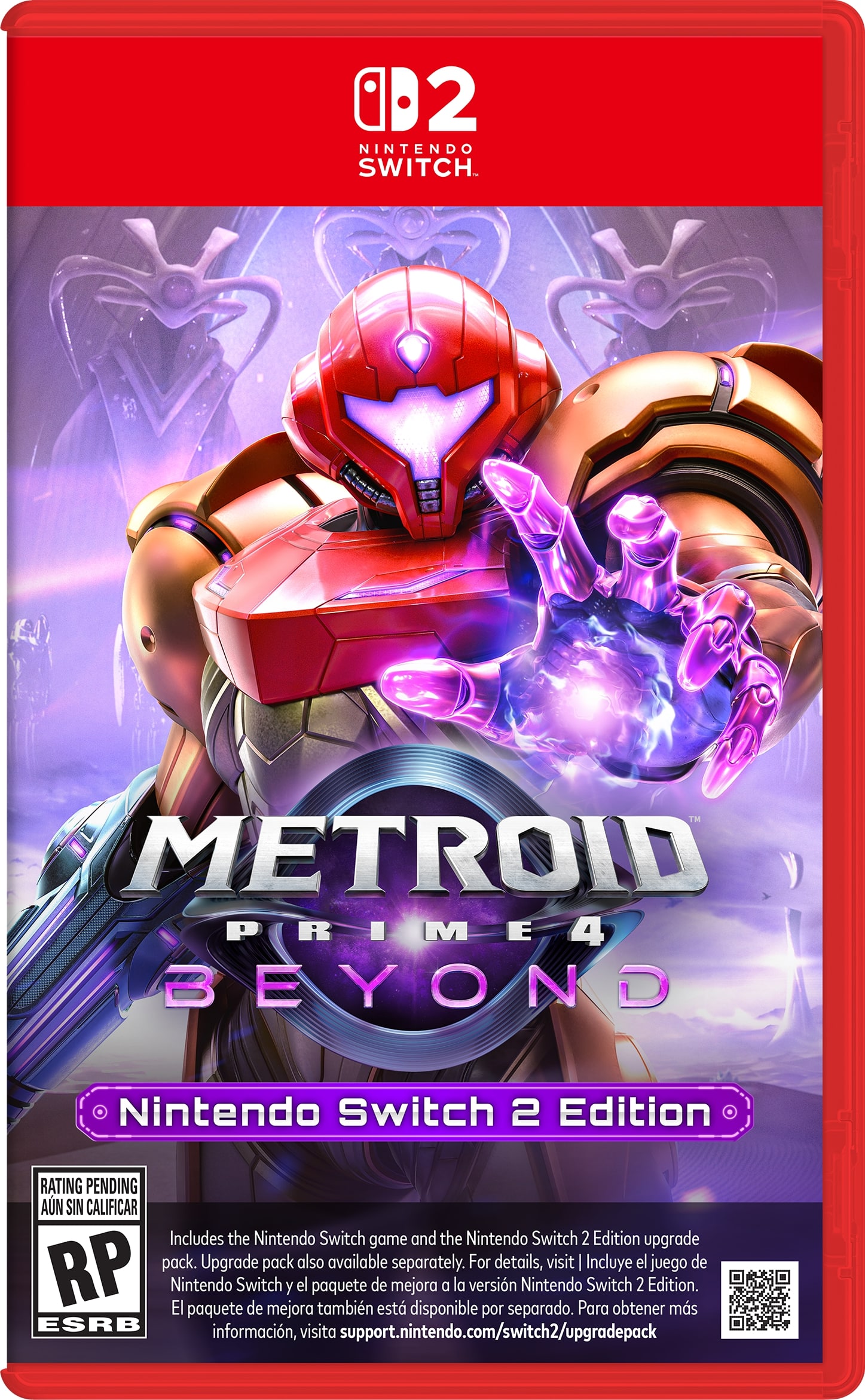
System: Nintendo Switch, Nintendo Switch 2
Release Date: December 4, 2025
Categories: Action, Adventure, Shooting
Publisher: Nintendo
Developer: Retro Studios

Written by Ricky Berg
When he isn’t writing for Nintendo Wire, Ricky’s anticipating the next Kirby, Fire Emblem, or if the stars ever align, Mother 3 to be released. Till then he’ll have the warm comfort of Super Smash Bros. to keep him going.
