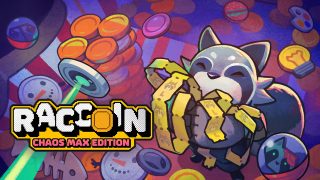

For the past week, I’ve been kissing any hope of productivity goodbye as I let a wily raccoon guide me into a rundown arcade with a cardboard coin pusher machine. I could have went to the existential poker table that is Balatro or the gritty prison cell slot machine that is Cloverpit but instead I’m here in Raccoin: Chaos Max Edition. Did I choose wisely?
Roguelites are interesting. They’re almost more of a game framework than they are a genre. Take an arcade game, a brawler, a sports game, or really any short form style of video game; and make it randomized and run-based with permanent progression gained upon fail state, and you have yourself a roguelite. Raccoin is the latest gambling roguelite to hit Nintendo Switch 2 and it’s safe to say it’s swimming in a crowded sea. Whether you’ll prefer it to its peers depends on how much you like the idea of luck driving your entire run. Personally, I did not.
Okay, so, Raccoin is great on paper: cute animal aesthetic that lends the otherwise grimy, “this will go off the rails” feeling a charm that’s easy to find appealing, interesting synergy mechanics, and, most importantly, attempting to redefine one of the most boring ticket redemption games as an exciting thrill. What Raccoin understands is that coin pushers have a certain drama to them. There’s excitement in the anticipation. One right move at the right time and you’re leaving with a mountain of tickets. But in real life you have the luxury of walking away. Here in Raccoin you need to win 15(!!) rounds or lose in order to be able to break away.
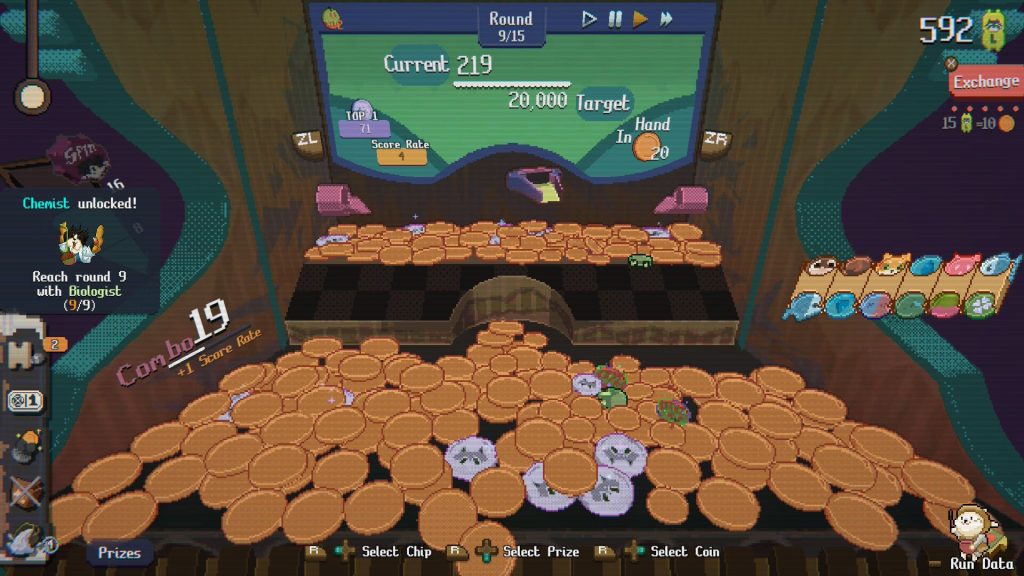
This all sounds simple and straightforward. It is. Until it isn’t. You see, I was surprised by how much depth Raccoin ended up having and even more surprised by the obtuse way it leads you into discovering all of its mechanics. There are eight character archetypes to choose from, two that are exclusive to Chaos Max Edition. You start with the Manager, the most basic of the characters. If you’re like me, you’ll keep trying over and over again to win all 15 rounds using the manager. And you might succeed but I sure didn’t. Stubborn ‘ol me didn’t want to try any of the other characters until I’d won a run with the most basic. Turns out, you NEED to play as every character as soon as they become available so that you can discover all of the game’s universal mechanics.
I’ll explain why I don’t care for this. The first character you can technically play as is The Manager but if you scroll to the left, The Owner (who houses the tutorial) is hidden away off the main character selection. This tutorial makes you believe that you’re being taught everything there is to the game: Shoot coins out of two tubes at the top of the machine to make them drop down to the bottom where a pusher will nudge them towards the scoring pit. Scoring coins moves a bar to the target score which if met wins you the round. If you run out of coins, you can use tickets to purchase more but this is a limited ability called an Exchange which refills each round. Tickets act as the shop currency as well, allowing you to purchase gadgets for the machine, special coins, chips (buffs) and prizes (which are temporary round-specific buffs). Your special coin holder can be expanded up to six times but, of course, because this is a roguelite, that allotment can be gamed. A multiplier is constantly being added to and filling up a meter that will allow a wheel to spin which can potentially spawn coin towers on the machine. Bad Coins also spawn and can halve your scoring rate, disable your gadgets/chips and even temporarily eliminate your exchanges.
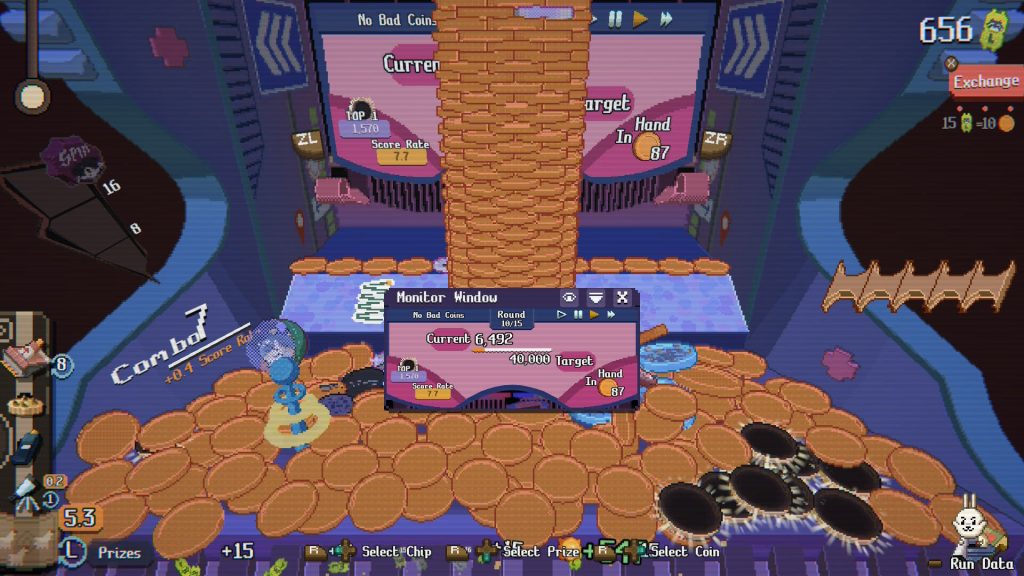
That brings me to the main thing I just don’t care for in Raccoin. I failed all of my first runs. And I’m meant to. The game is designed that way. All roguelites are. You’re supposed to fail so that the game can reveal all of the ways that you can turn the tide in your favor. In this case, did you know that the chemist can spawn special coins that cause explosions? Coins fly all over the screen. Raccoin becomes a Michael Bay scene real quick when this happens. Maybe you’d also like to know that there’s a whole animal coin ecosystem for The Biologist and you can breed the animal coins to create synergies. There’s even a cooking mechanic that the Big Eater introduces, complete with a frying pan placed in the machine. All of these ideas are creative and intuitive. Unfortunately, they involve having to play the most luck-based roguelite of them all. Truly, I can’t tell you how many times I thought I had a winning strategy and by round 11 I was staring at the screen with no exchanges left, 0 coins and staring at the pusher making no progress. This game will humble you. Even with your boldest strategies, if the right coins don’t spawn in the shop, you’re going to be digging in the trash can with the other raccoons who don’t own arcades.
The two most important factors in Raccoin are scoring rate and coin value. Each special coin has a different value that can be viewed when you hover your cursor over it and even standard gold coins’ value can be affected by special coins, prizes and chips. For instance, there are special coins that make gold coins into silver coins and apply a multiplier. This is all vital to winning, particularly scoring rate because it can carry you through to the end of a round with just a few coins. But even then, you’re beholden to Lady Luck. I could go on and on about how each character specializes in a different coin type (Math, Chaos, Animal, Food, Elemental, etc.), but the game suggests that the later characters’ coin types are more important. The two new characters in Chaos Max Edition, RAC-001N and The Creator, let you control a robot gadget inside the machine and choose any character class speciality with any coins respectively. Seeing that, I especially felt that I may as well just use The Creator. But maybe Raccoin makes it so obvious so that the player feels inclined to challenge themselves. No need. I felt challenged at every turn in this game. RNG dominated my progress. The prize capsules that spawned that held coin modifiers would often spawn after I had no special coins left and stickers that spawn on each side of the machine only spawned at the beginning of each round. So after a certain point in each round, it was easy to feel like no random Hail Mary was coming my way.
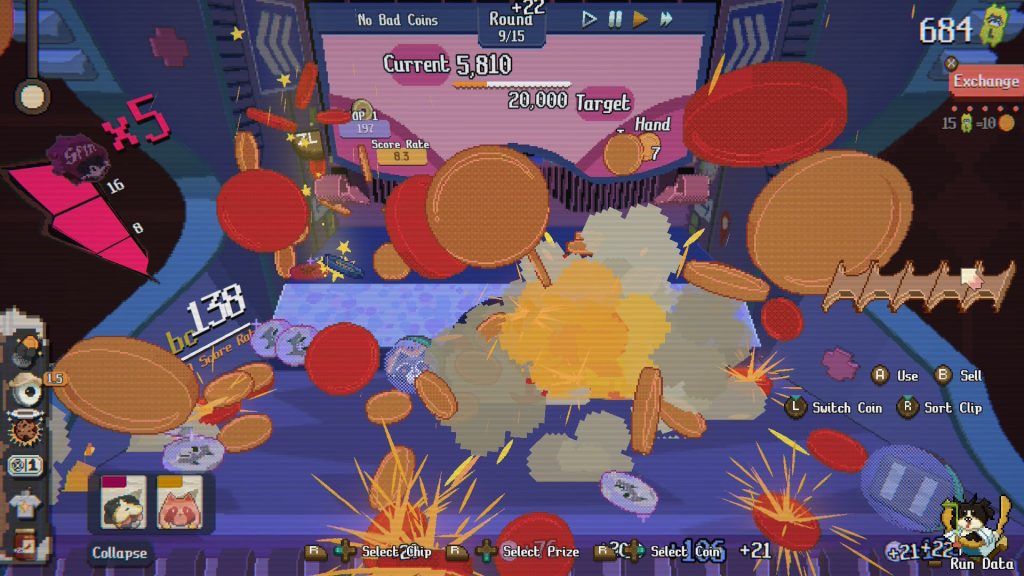
Raccoin: Chaos Max Edition earned its name. I caused the game to crash when a coin tower spawned and I attempted to detonate an Explosion coin. The game froze but the music kept playing. It was actually incredible and true to the nature of the game. Otherwise, performance was unshaken in handheld mode on Switch 2. Because I was using the left analog stick to control a cursor, the game felt 30 fps but the touch screen can be enabled for handheld play as well. It’s worth noting the gameplay speed can also be adjusted on the fly when in a run by pressing a toggle on the machine itself. I appreciated the immersion.
I just didn’t feel in control in Raccoin: Chaos Max Edition. It may as well be an idler or a clicker. In that way, it’s true to the arcade machine that inspired it. However, what Raccoin misses is the sense of collaboration. When you place a coin in a real coin pusher, another person did the same before you and their action can be the reason you end up winning. Raccoin’s arcade must just not be a booming business because when you show up, the machine acts as a blank slate as if everyone else before you blew right past the coin pusher machine and went straight to one of the three other arcade machines you unlock by winning runs. And actually, I think I enjoyed playing the game’s classic mode without all of the perks, buffs, and detriments that are trying to make it exciting. With all of this in mind, I would recommend taking a different gamble on Switch 2 over this one.
Leave a Comment
System: Nintendo Switch 2
Release Date: November 10, 2026
Categories: Strategy, Arcade, Simulation
Publisher: Playstack
Developer: Doraccoon

Written by Matthew Powers
Nintendo has been Matthew’s preference for fun video gaming since 2004. In addition to his love for all things Mario, Metroid and beyond, Matthew also enjoys heavy metal, roller coasters, pinball machines, and being a proud cat dad.
