


Developer Poncle has made a name for itself in the four years since Vampire Survivors launched in 2022. Releasing for budget pricing and offering a frankly ridiculous amount of value per dollar, Vampire Survivors became an overnight sensation for reasons that are maybe a bit hard to put into words. Sure, a lot of its mechanics and visuals are fashioned after slot machine interfaces and “addictive” casino gaming, but it’s also a relatively cheap purchase that doesn’t hound you for more money or block progression until you pay up. Its gameplay, if you can even really call it that, is more about setting up a build and letting things go on autopilot than it is about interlocking systems, multilayered skills, or even character positioning. Why is it so popular?
As someone who digs the game a lot, I’m not even sure I can properly explain it. I think Vampire Survivors simply tickles a part of my lizard brain that gets excited seeing an explosion of numbers flash across the screen. It’s the same type of thing that propelled Call of Duty 4: Modern Warfare to the forefront of gaming in the late ’00s: people liked seeing numbers dance around the screen when they shot someone. That’s not a perfectly apt comparison (Call of Duty, despite being too similar each year, has more depth than Vampire Survivors), but it does speak to an inescapable truth of entertainment mediums. Most people plug in to be dazzled.
That brings us to Vampire Crawlers, the first expansion of the Vampire Survivors brand into a new genre. Developed by Nosebleed Interactive with the blessing of Poncle (who is also serving publishing duties), Crawlers transposes most of the ideas and theming of Survivors into a roguelike, turn-based, dungeon crawling deck builder. It’s a lot of different things at once, though one that doesn’t feel far removed from the unadulterated overkill that Survivors could create. It certainly looks and sounds familiar, but does it nail the transition to an entirely different style of play?
Deal US In
Let’s back up a little to set the stage. Vampire Crawlers’ story is that you’re playing a video game where you collect cards to defeat monsters as you traverse castles that don’t actually have vampires. Wait, that’s not a story: that’s just the game. Similar to Survivors, this tongue-in-cheek presentation is one of the reasons Survivors hit so well for people. It’s reminiscent of the “good old days” of gaming where hyperkinetic action was the expectation versus any semblance of staging or plot. If you thought a dungeon crawler based on Vampire Survivors would include more story, then I’m sorry to disappoint you.
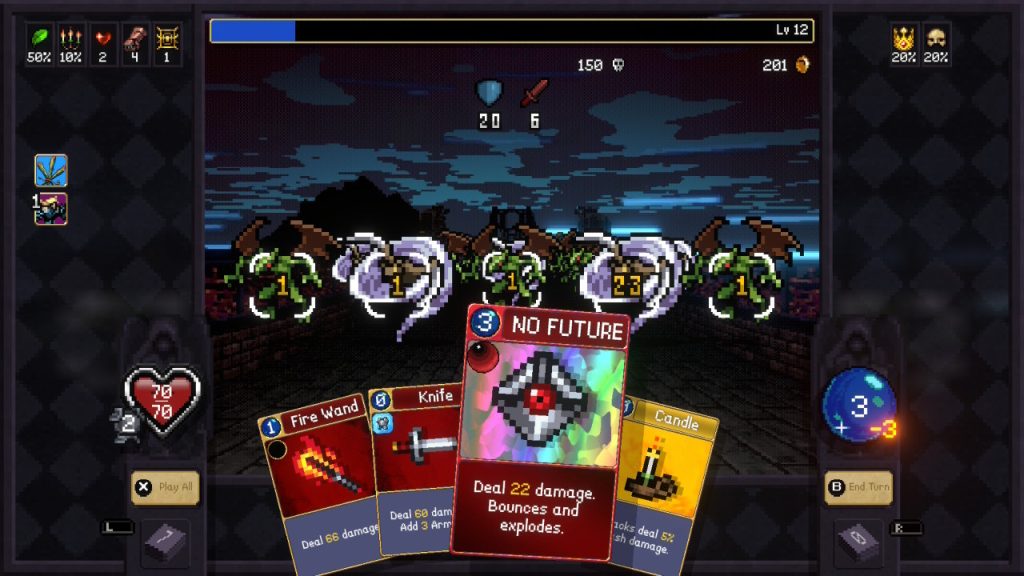
In its absence is the same kind of manic frenzy of numbers and flashing sound effects that you can find in Survivors. As I said, this is a dungeon crawler with turn-based deck building elements, so the general gameplay is easy to sum up. You explore relatively small dungeons floor by floor, step by step to battle monsters, find treasures, collect cards, and level up. Unlike Survivors, there isn’t a single element here that is real-time (save for one little mini-game that is impossible to fail), so the barrier to entry is actually quite a bit lower. You don’t often need to think on your feet to make progress in Crawlers, even if some monsters will challenge your understanding of the base mechanics.
Where most turn-based games would have you simply attack, there is one quirk to Crawlers’ combat. Each card in your deck is assigned a value of mana required to play it, similar to how Pokémon TCG or even Magic the Gathering work. While you can play cards in whatever order you want, playing them in ascending value will create a chain combo that amplifies the next card in the chain. It’s the one distinguishing factor to Crawlers that gives it a differentiating edge, and the trick to really capturing the madness that Survivors has.
Reading the Card Explains the Card
I’m jumping ahead of myself, but after you’ve acquired some power-ups and unlocked different characters, it’s not out of the question that you’ll be able to clear an entire boss horde in a single turn. The way different cards synergize together is really the main element that makes Vampire Crawlers so engaging. I do think more can be done with this idea, though, because what the base game has is a little light.
There isn’t much point in me explaining every system that Crawlers has because they’re all easy to understand. The game also has extensive tutorializing, so I’m not sure anyone could get lost unless they don’t pay attention. Vampire Crawlers seems purpose made to prevent that from happening, however, as turns taken in combat and traversal are snappy. I would be remiss to not explain some of the extracurricular things, at least.
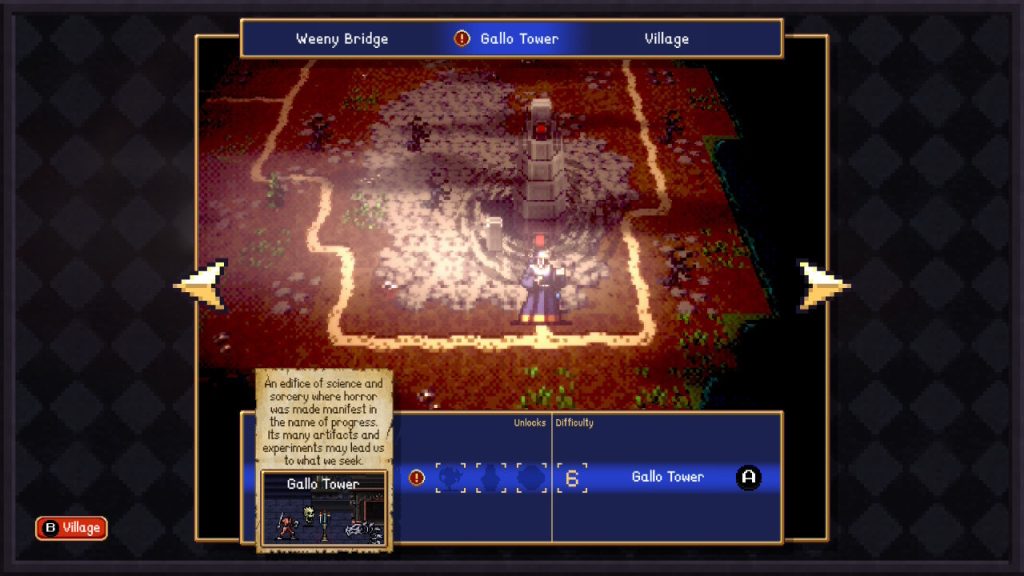
You’ll start the game by going straight into the action and probably dying. This gives you a quick understanding of how the bulk of your time in Crawlers will play out, but it also shows you that death isn’t a waste of time. When you perish in combat, you’ll be kicked back to your main village where you can upgrade specific powers, unlock new characters, or a variety of other options that are unlocked over play. These include things like applying Arcana for buffs, a Blacksmith to upgrade cards and tweak gem rarity, and a checklist of objectives to complete that unlock more levels and characters. It follows the same basic template of Vampire Survivors, right down to having you hit certain level thresholds with certain characters.
It perfectly emulates the options that Survivors gives players, which allow you to work towards micro and macro goals as you screw around in levels. Crawlers is a bit more directed in that beating one level unlocks the next, and so on, but then levels eventually start getting higher difficulty variants to call you back. There are also collectibles in the form of Relics on most stages that will throw new wrinkles into the mix, such as the aforementioned blacksmith, or the ability to add gems to cards, etc.
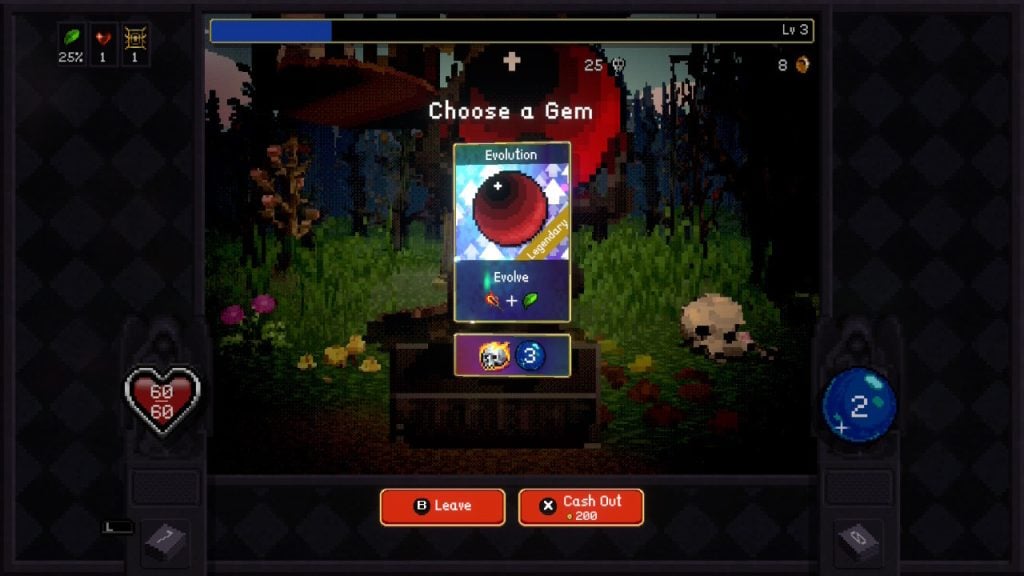
It’s through the relics, arcana, and blacksmith that I feel Crawlers becomes more than just a different take on Vampire Survivors. At first, I was worried the game wouldn’t evolve much beyond selecting random cards and trying to keep mana values ascending. It’s a little hard when you start since your MP typically begins at two, but it’s not impossible to play around. When you unlock the ability to plop gems into your cards, then you start to open up different possibilities for utterly breaking each encounter. There’s a wide range of gems, but one of the most obviously useful is a double damage modifier. With that, the specific card the gem is applied to will hit harder, and thus help you overcome battles quicker. Another might restore health with each hit, or give you HP back at the end of a battle, so there is a layer of planning involved with how you apply them.
This plays in conjunction with the power ups, which are exactly the same as how they work in Vampire Survivors. After collecting enough gold, you can permanently increase the amount of XP you earn for battles, how much gold you acquire from pick-ups, how much damage enemies do, etc. It’s all the same staples of the roguelite genre that grant player progression while allowing the actual gameplay to be a clean slate each round. It was also key to why people gravitated towards Survivors since it provided a means of outpacing the game’s various enemies.
(Not) Vampiric Tutors
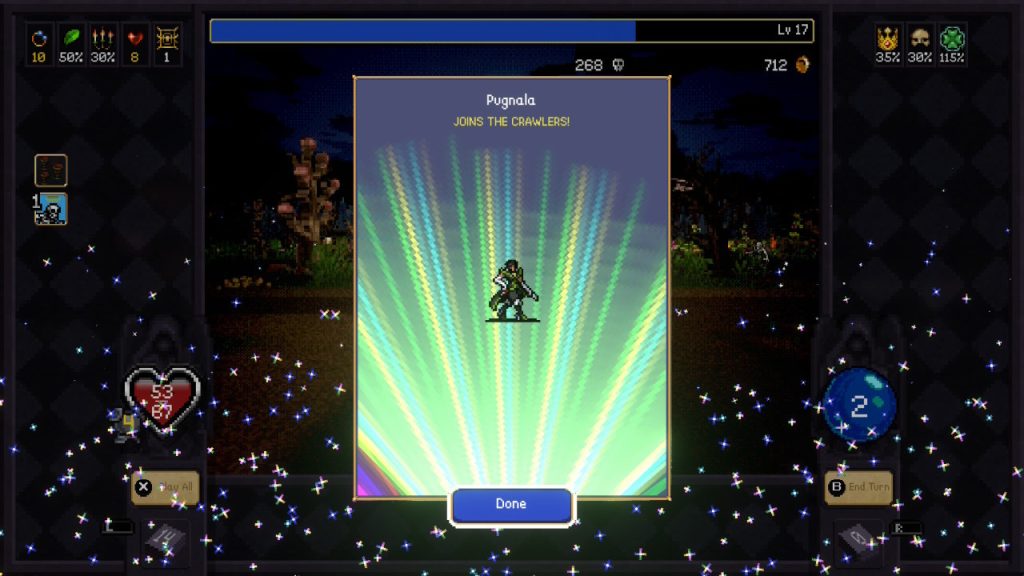
That doesn’t even get into how characters work, which is maybe the one element that doesn’t feel the same as Vampire Survivors. In Survivors, characters were mostly like classes in a traditional RPG that gave you starting items, but were otherwise blank slates. In Crawlers, characters have attributes based on the colors of the cards played and are also cards themselves. The starting character Antonio, will add two armor when played and will increase damage output by 10% when a red card is played while he is active. Since you can only amass cards after leveling up, playing as Antonio will naturally shift your choices towards red cards more than others.
I wish it happened sooner during the course of a playthrough, but you will eventually happen upon a relic that lets you select multiple characters at once. You need to unlock it by amassing quite a chunk of gold, but by going into runs with three characters, Vampire Crawlers starts to become ludicrous in the exact way that Vampire Survivors would. By the time I finished the main game, I had a team that would deal 25% extra damage by default, could amass a percentage of revives every time I played a wild card, and would gain 25% extra gold each time I played a wild card. Not only that, but one special ability of my team was that yellow cards would automatically draw four more cards, so at points, I had turns that would wipe out entire encounters without stopping. By curating my cards so that I had an ample supply of wild cards (which extend combos without spending mana or resetting the number), I was able to deal a ton of damage, wild card to reset the number, then play a mana card that would now give me 12+ mana. If you’re ever in that situation — repeat the process once or twice with a combo modifier of 20, and you’re basically home free.
It’s that type of action that I wish Crawlers provided more of. I know why the game is so light from the get go, because that’s exactly how Survivors launched. It’s hard to think about now after the game has received four paid expansions and two free ones, but Survivors’ original release was a pretty brisk 15 hours of stuff before you were done. Crawlers is that, just in a different genre. There is the foundation for something bigger in the future, which Poncle even straight up admits on the Steam store page, but at present, there isn’t enough content that pushes players to really think big. There is a lot to unlock and the way you can modify cards should allow you to truly bend the game to your will, but the truly game changing unlocks are so late in the game that you’re essentially done before you can really tinker with anything.
The only time I got stuck, if you even want to call it that, is when I was attempting to use a rather weak character in a harder level. One of the goals was to get them to level 30, and it was simply too hard to do on a difficulty six stage. I just took them to an easier level, did the challenge, then proceeded to use a different character to continue on. I do think limiting levels to certain characters would demand more strategic play, but then the very idea of both these Vampire games is that they act as a form of power fantasy. You’re meant to be a literal god by the end of a round, and that type of power escalation doesn’t flow with limitations on characters.
The thing is, Vampire Survivors eventually added options to limit yourself for challenge runs, not to mention a whole host of stat tracking to see which levels you’ve beaten with which characters and even how many of each monster you’ve killed, etc. Vampire Crawlers, conversely, has none of that. The only way you’ll know if you’ve accomplished something like “Reach Level 20 with Imelda Belpaese in Inlaid Library” is because it’s one of the unlocks. Once done, that’s it. Since you can’t turn off leveling up to prevent yourself from gathering more cards, you also can’t limit yourself to single weapons or items (Banish is still here, but you have a limited number of those). For that matter, I don’t know if I’ve even used every character because I eventually just went with the strongest one for my preferences.
A More Cursed Night
All of this is to say that I think Vampire Crawlers is set up to be a rather beefy game at some point in the future. It took me a good 15-20 hours to finish, but when I was through, I didn’t feel quite satisfied. If this were the debut game from a new studio with no prior example, I likely would have been quite surprised by how thought out the unlock system was. Since this is releasing in the wake of nearly half a decade of Vampire Survivors, I know more can be done. I’ve seen how Poncle refined and expanded its surprise hit over time, and I’m curious why Nosebleed Interactive didn’t at least incorporate more of those elements from the get go. The content on offer is fine and it would be silly to get mad over a $10 game not having truckloads of levels to burn through, but why are the options so scarce?
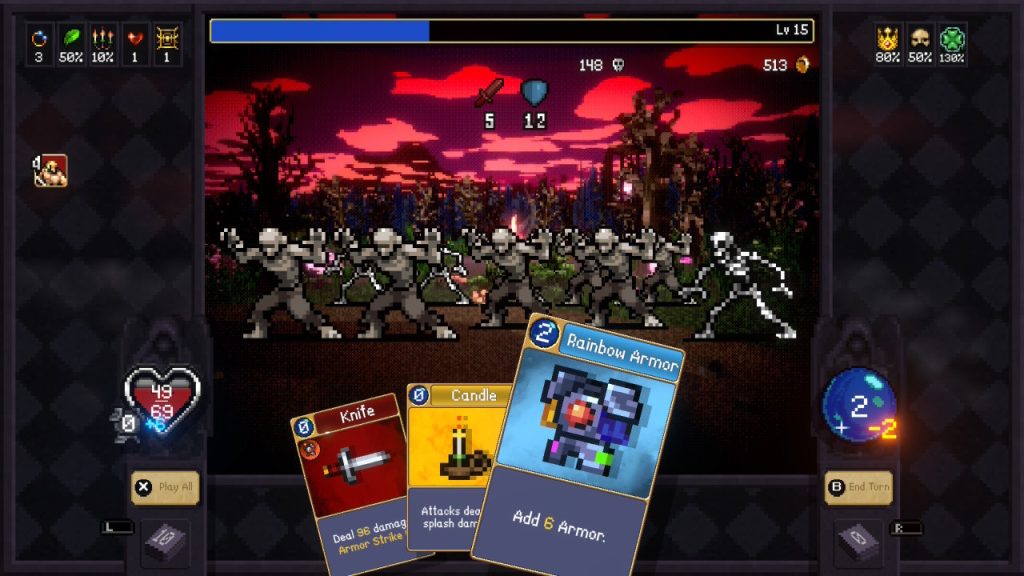
Taking a quick aside for technical discussion, I played the Nintendo Switch version of Vampire Crawlers for this review as Poncle did not announce a Switch 2 port ahead of the review window. It runs perfectly fine on a Switch 2, though there is some slowdown when mixing too many weapons at once. The text can also be a little blurry on a 4K display, but the pixel art nature of Crawlers means the visuals hold up pretty well when blown up to a big screen. You can use boost mode to get 1080p in handheld, so scaling isn’t an issue there. I imagine the listed Switch 2 version fixes these issues, but there doesn’t seem to be an upgrade path available. There’s no indication of save transfers either, so make sure to buy the appropriate version for your console ahead of time. The review code had some bugs and glitches (not to mention crashes), but those are said to be fixed in a day-one update.
Ultimately, I like Vampire Crawlers quite a bit. I think my expectations were set too high from what Poncle delivered with Vampire Survivors. I can’t rate games based on what I think they will become, though, only what they are right now. At the current moment, Crawlers is merely okay. It’s got a bedrock to build on that should see it eventually morph into a great game. I don’t doubt that Poncle will guide it towards becoming the best version of itself in the years to come.
Leave a Comment
System: Nintendo Switch
Release Date: April 21, 2026
Categories: Action, Tabletop
Publisher: poncle
Developer: poncle

Written by Peter Glagowski
Peter has been a freelance gaming and film critic for over seven years. His passion for Nintendo is only matched by the size of his collection.
